The Republican polling firm of Public Opinion Strategies announced today that it is resigning from Senator Arlen Specter’s campaign team.
“Senator Specter has been a record-setting U.S. Senator, and we have been part of his campaign team in 1992, 1998, and 2004, but because of his surprising decision to switch parties today, we will no longer be involved,” said Glen Bolger, a Partner in the firm who worked on the ‘98 and ‘04 campaigns. “As Republicans, we are disappointed by Senator Specter’s decision.”
Public Opinion Strategies polls for 15 Republican U.S. Senators and one Independent. Republican Senate incumbents include Richard Burr, Saxby Chambliss, Thad Cochran, Bob Corker, Mike Crapo, Jim DeMint, John Ensign, Jim Inhofe, Mike Johanns, John McCain, Pat Roberts, Olympia Snowe, John Thune, David Vitter, and Roger Wicker.
(The article was co-authored by Matthew Jason.)
All politics aside, Americans still view President Obama, the man, very positively. On our recently completed Public Opinion Strategies “100 Day National Survey,” an amazing seventy-nine percent (79%) of the voters we talked to told us they like President Obama as a person. However, a more specific question about whether or not voters like the policies of President Obama shows that our new leader is not in nearly as positive a position as the seventy-nine percent (79%) personal popularity would indicate.
Just fifty-five percent (55%) of Americans say they like President Obama’s policies. This is still a solid majority, but the economic conditions in this country are still not improving, and these numbers show that Obama’s charismatic personality can only carry him so far. A time will come when Americans look for positive visible results and an improvement in the lives of they and their families. If President Obama and the Democrats cannot deliver such results, voters will be open to Republican alternatives.
Has the Republican Party and its leadership developed any alternative plans? If they have, Americans are not yet aware of it. At this point, only fourteen percent (14%) of American voters say they have heard a lot about Republican alternatives. Another thirty-two percent (32%) say they have heard at least “some” about Republican alternatives, but our experience tells us that a portion of the “some” response is voters who are just trying to save face and not appear uninformed to the person interviewing them. Even if you assume all the “some” voters are being truthful, this means that less than half (46%) of voters have seen anything substantial about a Republican alternative to the policies of President Obama.
Asking the Republican alternative question a little differently, only thirty-eight percent (38%) of the American voters we interviewed said they believe the Republican Party has even offered any credible policy alternatives to President Obama’s economic programs. According to our survey, a majority (52%) of American voters believe that Republicans currently have a policy of simply opposing whatever Obama proposes.
These voters may not be locked into Obama and the Democratic Party, but they are also not likely to quickly jump to the Republican Party unless they are given a reason to do so. Hoping for the country to continue to have major problems and rooting for President Obama to fail is not a legitimate strategy. The challenge for the Republicans Party as a whole, and especially for the individual candidates all over the country, is to come up with credible proposals of their own which communicate Republican ideals to voters in an understandable and convincing manner.
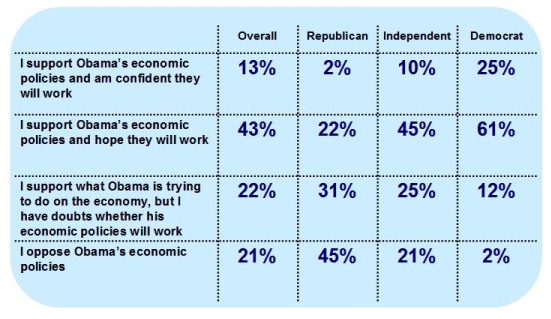
When POS’ Obama: 100 Days In survey asked Americans how they felt about President Obama’s economic polices, most American found themselves hopeful but firmly in the middle.
Only a handful (13{09f965da52dc6ab4c1643a77bd40d1f729d807040cd8db540234bb981a782222}) count themselves among supporters who are confident that the new president’s economic policies will work. SHOCK: The new president can only count on one-in-four (25{09f965da52dc6ab4c1643a77bd40d1f729d807040cd8db540234bb981a782222}) of his own Democratic partisans to share this view. On the other side, 21{09f965da52dc6ab4c1643a77bd40d1f729d807040cd8db540234bb981a782222} oppose Obama’s economic policies from the get-go . While the president can count on only 25{09f965da52dc6ab4c1643a77bd40d1f729d807040cd8db540234bb981a782222} of his own partisans for bedrock support, nearly twice as many Republicans (45{09f965da52dc6ab4c1643a77bd40d1f729d807040cd8db540234bb981a782222}) already count themselves among the opposition.
The fact that Republicans are already galvanized against the president is well reported. The real future lies in how Obama’s economic policies play among the Independents who make up just shy of a third of the electorate (32{09f965da52dc6ab4c1643a77bd40d1f729d807040cd8db540234bb981a782222}).
As Dan Akroyd said in the ‘80s libertarian cult film, Ghost Busters, “I myself have worked in the private sector. They expect results.”
So will Independents when it comes to Obama.
Like all Americans, Indies are feeling the pocketbook pinch. And, at Obama’s 100 day mark, the bulk either are supportively hopeful of Obamanomics (45{09f965da52dc6ab4c1643a77bd40d1f729d807040cd8db540234bb981a782222}) or doubtfully supportive (25{09f965da52dc6ab4c1643a77bd40d1f729d807040cd8db540234bb981a782222}).
Together, they account for 22{09f965da52dc6ab4c1643a77bd40d1f729d807040cd8db540234bb981a782222} of the nation’s voters and 70{09f965da52dc6ab4c1643a77bd40d1f729d807040cd8db540234bb981a782222} of the voters who will decide the fate of Obama and his party. If they don’t feel juiced by the Obama Economy, it will be Independents who swell the ranks of Republicans in 2010’s mid terms.
Postscript: With three-of-four Republicans either doubtful or opposing Obamanomics outright, there is little incentive for their leaders to do anything other than point out its deficiencies and say how they would do better.
Back in the good old days (pre-2005), Republicans used to have messages that resonated with voters. In the 2006 cycle, the illegal immigration message tested well, but it did not end up moving swing voters who were more focused on Iraq and the economy. In 2008, we finally started getting traction with the need for a well-rounded energy plan that included BOTH domestic drilling AND alternative energy, but then the economy crashed and gas prices tumbled.
Now that the GOP has fallen back to where we were after the 1992 elections, Republicans are casting about for messages that resonate. While our current survey provides only a glimmer of insight into the policy areas that might provide the GOP with a direction, it shines a clear spotlight on voters’ desire to place a few speed bumps directly in the path of the Obama Administration’s policies.
Our latest national survey provides strong evidence that voters are concerned that they have given too much power to one political party, and that Republicans can provide a check and balance.
We asked two questions directly related to the “check and balance” question, and both worked extremely well:
Now, thinking some about the election for US Congress, for whom would you vote between:
34% A Congressional candidate who will help Barack Obama and the Democrats in Congress pass their agenda.
…or…
56% A Congressional candidate who can be a check and balance to Barack Obama and the Democrats in Congress.
And. . .
And, do you agree or disagree with the following statement…
Since Democrats have complete control of Congress and the Presidency, it would be good to have more checks and balances in Washington by electing more Republicans to Congress.
In the past few years, there have been very few messages that have gotten close to half support when tied explicitly with the Republican party, much less majority support.
Obviously, the message works with Republicans (89% agree), but also with Independents (55% agree). It also works well with other groups GOPers have found challenging B women (51% agree), younger voters (52% agree), Northeastern voters (52%), suburban voters (57%), and even moderates (45%) and unmarried women (46%). (The latter two groups aren’t majority support, but they’ve killed GOPers in the last few elections, so anything close is helpful.) Even 30% of conservative Dems agree (and they give Obama a 90% approval rating).
Keep in mind the context of these questions – Obama is above 60% approval, Democrats hold a seven-point national partisan advantage, and recent image scores of the national GOP are in the toilet.
Why then do voters so overwhelmingly opt for these checks and balances? Voters have been traditionally uncomfortable with the idea of too much power concentrated in the hands of one party. They believe it leads to too much spending and to corruption (sound familiar?). My theory of why the generic ballot has tightened despite a lack of movement on the party ID deficit is that voters are worried they overcorrected in 2008. Giving this kind of unchecked control to one political party in Washington is the equivalent of giving whiskey and car keys to a teenage boy.
“Checks and balances” is no substitute for policy alternatives, but it does provide an opening for the GOP to be heard on the issues and to put a few speed bumps in the way of the liberal rush to spend as though there is no tomorrow – and no need to pay it back.
There is no question that Republicans ought to use this message, and it ought to be tied to the area where Democrats are most vulnerable B too much spending. While this may not end up being a campaign’s main message, driving the point that “A vote for me is a vote to send a watchdog to Congress who will fight to make sure the Democrats don’t go out of control in spending. We need a check and balance in Washington to rein in the wasteful spending and the corruption that comes with one party control.”
Public Opinion Strategies just completed a national survey of voters, drilling down on attitudes both toward Barack Obama and toward the Republican Party.
Along with key measures of attitudes toward the President, the Congress, and the Republican Party, the survey takes an in-depth look at attitudes towards Obama’s economic policies, concerns about his Presidency, his ideology, potential GOP messaging, the Tea Parties, and social networking sites.
We have already poste a few articles on the blog, and will continue to do so throughout the week. Check back daily.