It was a revelatory moment when I moderated a focus group of Congressional Hill staffers earlier this year and they laughed, no, jeered really, at the mention of billions of dollars.“Billions?” one scoffed.“It’s all trillions these days.”
Such may be the warped world of Washington, but at least spending trillions of taxpayer dollars has not gone unnoticed by the American public.In fact, increased government spending at a time when more Americans are placing tighter reins on their own purse strings is one of the greatest concerns voters have about the President in these early days of his first term.
The latest national survey conducted by Public Opinion Strategies demonstrates that increased government spending and tackling too many things at once are the major concerns of voters when asked to choose their greatest concern about the President:
26%His proposals for increased government spending go too far
26%He’s trying to take on too many issues
15% His proposals will result in higher taxes
15%He’s not winning bipartisan support for his policies
4%He’s too focused on foreign affairs
The concerns about the President taking on too many issues or not receiving enough bipartisan support are largely attributed to his core supporters.However, concerns about government spending rise to the top among some voter sub-groups important in the next election.For example, in 14 key swing states, and similarly, in states where Obama won with less than 5% of the vote, voters’ top concern about the President is that government spending has gone too far (28% and 27% cite the issue, respectively).Moreover, voter sub-groups who tend to pay the most attention to public policy – college-educated voters, opinion elites and those who say they follow politics closely – are all more likely to cite the increased government spending as their major concern.
The impact on the deficit is clearly connected to this concern about government spending, based on other research we have conducted.A recent AP survey of adults conducted April 16-20th demonstrated that “nearly 80% believe that the rising federal debt will hurt future generations.”Fellow POS partner Bill McInturff’s polling on behalf of NBC/Wall Street Journal (conducted with Democratic pollster Peter Hart) showed last month that Americans are skeptical that the President will be able to make a dent in all this debt.Just 31% said that it is likely that Obama will be able to “cut the federal deficit in half by the end of his first term.”
With the cavalier attitude demonstrated recently by those on the Hill, voter skepticism seems quite well founded.
Our most recent national survey asked a battery of questions on President Obama’s economic policies and the stimulus. In a nutshell, when it comes to Americans:
55% support it;
56% support it and either believe it will work or hope it will work;
57% believe it will help most Americans, and
50% believe it will help they and their family.
The average of the above tells the story: A majority of Americans currently support Obamanomics – a little more or a little less depending on the wording. President Obama gets props for good intentions and doing something. Anything.
Our survey also shows there is nothing in it for Republicans to do anything other than to point out the Stimulus’ deficiencies and say how they would do different to cure Americans’ economic ills. Straight up, three-out-of-four Republicans (75%) oppose it from the outset – more than half (52%) strongly so.
Just as Republicans form the core of the opposition (this scribe included), Democrats form the rock solid core of Obama’s lackeys – 87% of his partisans support the stimulus package.
So, saying “no” is a good rallying cry, but it won’t be enough for the GOP. The problem for Republicans is that there are still not enough Republicans (Democrats outnumber Republicans 37% to 30%). The GOP needs dissatisfaction with President Obama to brew and fester to expand its ranks.
Where are GOPers going to get more bodies to even the score? The real guts are the folks who are in the middle on the Obama economy; those who are doubtful, split or divided. Where they go over the next year will decide whether or not Obamanomics keeps rolling or leaves the tracks. The Independent-minded voters in the middle make up just short of one-third of the electorate (32%).
These voters could be the GOP’s recruiting ground, but only time and the stimulus results will tell. Independent-minded Americans aren’t fully with Obamanomics, but they are far from being against it. The data show 54% of the Independents support Obama’s policies and hope the policies will work and half (50%) favor the stimulus bill signed into law by President Obama.
But will it work and when? What will happen if it doesn’t?
Forty-five percent of the Independents oppose the stimulus from the get-go, and only 33% say it has started working (55% say it hasn’t). Short of half (47%) say it will help most Americans and 41% say it will hurt most Americans.
These last three data points are important because they gauge the impact of time and economic muscle on voters’ support. Right now, the Independent voters Republicans need to forge a plurality are giving President Obama a narrow pass. But, the clock is ticking for Obamanomics to pay off for Independents. He has four or five quarters to produce or these voters will look elsewhere in the ‘10 mid-terms.
Results of the latest NBC-Wall Street Journal survey conducted by Bill McInturff of Public Opinion Strategies and Peter Hart of Hart Research Associates are available. The national survey was conducted April 23-26, 2009 among 1,005 adults.
Republican pollster Bill McInturff, who conducted this survey with Democratic pollster Peter D. Hart, says these numbers suggest “someone who is wearing well” with the public at this stage of his presidency. McInturff, in fact, even compares Obama’s early likeability to Ronald Reagan’s in the 1980s.
Peter Roff quotes Kinney’s post in a US News blog post about Specter and Republican chances.
McInturff is also quoted in a NBC story about the WSJ/NBC poll:
In the NBC/Journal poll, 43 percent say the country is on the right track, compared with an equal 43 percent who say it’s on the wrong track.
Yet that’s a 17-point jump since January, when just 26 percent believed the nation was on the right track. And it’s a 31-point increase since October 2008, when only 12 percent thought that.
“That’s an extraordinary movement,” McInturff says. “It means after 100 days that he has latitude to really govern with some potency.”
[…]
And more than six in 10 oppose any kind of criminal investigation into whether the Bush administration committed torture.
McInturff says these findings suggest that Americans don’t want to litigate the past. “This is a country that wants to move on,” he said. “What people are saying is, ‘Bad things may have happened… But whatever happened, it is in the past.’”
Glen Bolger’s post regarding the effects of Republicans presenting themselves as a check and balance against the Democrats in power has generated some discussion in the past couple of days.
A good discussion on the subject is posted by Matt Dabrowski at The Next Right who refers to Glen’s post as a “must-read.”
Battle Born PAC presents some other data along with the post on checks and balances to make the claim that the American people want Republicans in control of Congress.
A discussion of Specter’s switch at Outside the Beltway also mentions the POS statement on the move.
Voters were not misguided when they elected Barack Obama last November. They knew he was liberal, but it just didn’t matter because he wasn’t George W. Bush.
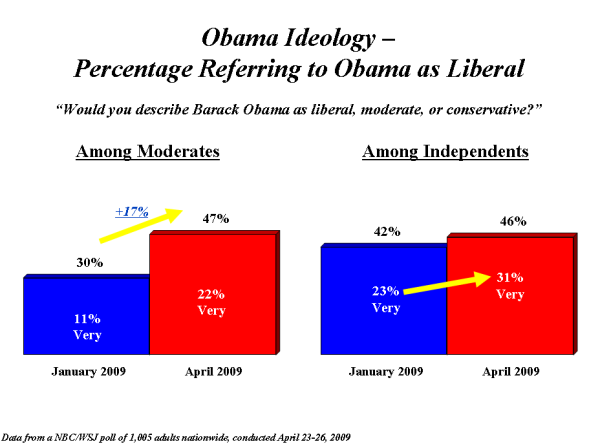
The Obama Administration’s sharp turn to the Left since taking office is starting to leave a mark on voters. In the latest NBC/Wall Street Journal survey, voters labeling Obama “liberal” in his political ideology moved markedly upward. Fifty-eight percent (58{09f965da52dc6ab4c1643a77bd40d1f729d807040cd8db540234bb981a782222}) of voters now consider Obama a liberal in his political leanings compared to 49{09f965da52dc6ab4c1643a77bd40d1f729d807040cd8db540234bb981a782222} when Obama took office in January.
This marks the liberal high-water mark for Obama since the election peak of 59{09f965da52dc6ab4c1643a77bd40d1f729d807040cd8db540234bb981a782222} in June of 2008. Notably, those voters labeling Obama “very liberal” has now hit its highest point ever at 36{09f965da52dc6ab4c1643a77bd40d1f729d807040cd8db540234bb981a782222}.
Obama’s ideological leanings are clearly out-of-tune with the American electorate. From our POS 100-day National Survey, fully 52{09f965da52dc6ab4c1643a77bd40d1f729d807040cd8db540234bb981a782222} of voters consider Obama to be on their ideological Left. What is even more interesting is that a significant chunk of Democrat voters place Obama to their ideological left as well. One out of five Democrats (21{09f965da52dc6ab4c1643a77bd40d1f729d807040cd8db540234bb981a782222}) believe Obama to be more liberal than they are.
Where is the shift in perceptions about Obama’s ideology coming from? It is actually coming across the political spectrum. Certainly, some of the shift is coming from Republican quarters. Seventy-two percent (72{09f965da52dc6ab4c1643a77bd40d1f729d807040cd8db540234bb981a782222}) of Republicans referred to Obama as liberal in January – that number is now up to 80{09f965da52dc6ab4c1643a77bd40d1f729d807040cd8db540234bb981a782222}.
Importantly, some of the movement has also come among Independent voters and moderates.
Interestingly, Democrats are also moving to a more liberal view of the President. Nearly half of all Democrats (48{09f965da52dc6ab4c1643a77bd40d1f729d807040cd8db540234bb981a782222}) consider Obama liberal today compared to 38{09f965da52dc6ab4c1643a77bd40d1f729d807040cd8db540234bb981a782222} when he took office in January. (I suppose Democrat voters would consider this a good thing.)
American voters knew they were electing a liberal as President – he was no liberal in disguise. But how liberal is too liberal for American voters now without a Bush to fall back on?