Last week, I posted a couple of entries looking at the tightening of the generic ballot (in comparison to 2005-2008) despite the challenges that remain for the GOP. This post looks at key subgroups — other than GOPers, Independents, and Dems (they were covered last week) — on the generic ballot.
The most striking finding is the huge gender gap — men vote GOP by a 48%-33% margin, while women break 31% GOP/50% Dem. That’s a staggering 34 point gender gap. The fact that there is a gender gap is not news — it’s been around since at least the 1980s. However, a gap of more than 25 points is unusual, and 30+ points is staggering.
Looking just at white voters, the gender gap is 29 points, with white men voting strongly GOP (53%-28%), while white women are close (37%-41%).
The gender gap cross generational lines. It is 39 points with 18-34 year olds, 34 points with 35-54 year olds, and 33 points with 55+ers. Of further concern to GOPers is that we are losing younger women by 40 points, but also trailing 41%-42% among younger men. Much has been written about our challenges with younger voters — it is a problem that applies to both women AND men.
Another way to look at the gender gap is to look at education. Men with college degrees are voting 53%-27% for the GOPer. Women with college degrees break 35% GOP/47% Dem — a 38 point gap. Men without college degrees stay with the GOP by a 44%-39% margin, while women without college degress are strongly anti-Republican — 28% GOP/53% Dem.
By income, Republicans do their best with women over $80k, while Dems actually lead among men with less than $40k.
Regionally, the GOP is seeing some improvement in the Midwest, but still has major problems in the Northeast. The Northeast goes Democratic on the generic ballo by 15 points, while the Midwest is tied. The South remains good (43% GOP/38% Dem), while the West breaks 41% GOP/46% Dem — an improvement from 2008.
Ideologically, conservatives break 65% GOP/21% Dem, while liberals are united (6% GOP/78% Dem). Moderates provide the Dems with a huge boost, breaking 27% GOP/48% Dem. Before anyone concludes from the greater unity among liberals that conservatives aren’t unified, it’s important to recognize that liberals are only 16% of the electorate, compared to 42% being conservative. Thus, the 78% Dems get from libs isn’t anywhere close to the 65% that GOPers get from conservative voters.
Church attendance continues to be a solid predictor of vote. Among those who attend weekly or more often, the GOPer wins 47%-35%. Among voters who occasionally attend church, it breaks 35% GOP/42% Dem. Those who may go a couple times each year (or never), the margin is a wide 32% GOP/51% Dem.
It’s hard to argue about the data — but it’s easy to argue about what the data means. A couple of conclusions for Republican campaigns going into 2009/10 elections:
Women are a key target group. We can’t expect to win them, but we do need to improve significantly with women. Keeping the Dem margin down among women often means a GOP win.
Younger voters are so anti-GOP that individual candidates need to work extra hard to win them over. The approach (at this point) shouldn’t be to get them to vote GOP, but to get them to vote for individual Republicans.
GOP campaigns shouldn’t expect to win either group (women or younger voters), but we also can’t expect to get blown out among those two groups and win. Targeting and messaging to both groups should be a key priority.
Howey Politics Indiana reported on the the tax protests that occured on April 15th, mentioning the POS poll conducted earlier this month about tax caps.
Speaker Bauer began his April 15 tax day in a rather bizarre mode, too. First, he killed the property tax caps even though a recent Public Opinion Strategies Poll showed the public supports it 72-20 percent. He refused to let U.S. Rep. Mike Pence address the House chambers, much to the protest of House Minority Leader Brian Bosma. And he did everything he could to adjourn the House prior to the 4:30 p.m. tax day tea rally by the Simon headquarters, citing “security concerns.”
FWDailyNews.com also mentions the tax caps poll in an article discussing Indiana Democrat’s resistance to many of President Obama’s proposed reforms.
The Wall Street Journal released its latest monthly poll of leading economists this week, and the average prediction of the 53 economists interviewed on the survey was that the recession the United States is experiencing will be in the past by September. Does this mean the recovery is at hand, and Americans can start actively shopping for new cars and homes? Not exactly. The same economists predicted that the economy will not recover enough to bring down unemployment until at least the second half of next year. In fact, the economists predicted that another 2.6 million Americans will lose their jobs in the next 12 months. When Brian Williams, Charlie Gibson, and Katie Couric come on television this fall and tell America that the President’s economic stimulus plan has worked and the recession is over, these will probably not be words that resonate all that much with most Americans.
What Americans need to understand here is that the country is not just experiencing a normal, garden variety, recession. What the country is likely experiencing is more serious than a basic recession. Dictionary.com defines a recession in basic terms as “a period of an economic contraction, sometimes limited in scope or duration.” To be a little more definitive, most economists say there is not a recession unless GDP (Gross Domestic Product) is negative for a period of two of more consecutive quarters. What America is experiencing is a period during which business, employment, and stock-market values have all declined quite dramatically.
Recessions then, by their common definition, are over as soon as a fiscal quarter takes place where GDP is not negative. It is unlikely that most Americans will see this recession as over as soon as one slightly improved quarter is in the books. Despite what they may hear on the evening news later this year, the effects of this recession will still be there. Most Americans will not again be optimistic about their country’s economic well being for quite some time. Using the Michigan Consumer Sentiment Index, my partner Bill McInturff did some research last month for a blog entry that many of you have read. If not, it is definitely worth reading. The long and short of it is that it takes at least two to four years before consumer sentiment really bounces back, and we are now only at the one year mark.
While there is definitely a question whether or not the recession will be over this year, let us take the economists at their word and presume fourth quarter GDP is in positive territory and the recession is officially over. What impact could this turn of events have on the 2010 midterm elections? If history repeats itself, as it so often does, a recession ending in September of this year could be very detrimental to Democrats in Congress. The last recession our country experienced officially ended in middle to late 1991, and the unemployment rate did not reach its climax until June of the following year, the year Bill Clinton was elected President of the United States.
If the economists are correct, the timing for the 2010 midterm elections will be eerily similar, and the Democratic Party, which now has all the perceived power to change the country’s financial conditions, could face the same uphill battle that George H.W. Bush did under very similar circumstances in 1992. It may or may not happen, but it sure would be nice to see Republican candidates around the country rallying behind Clinton’s now famous campaign slogan. “It’s the economy, stupid.”
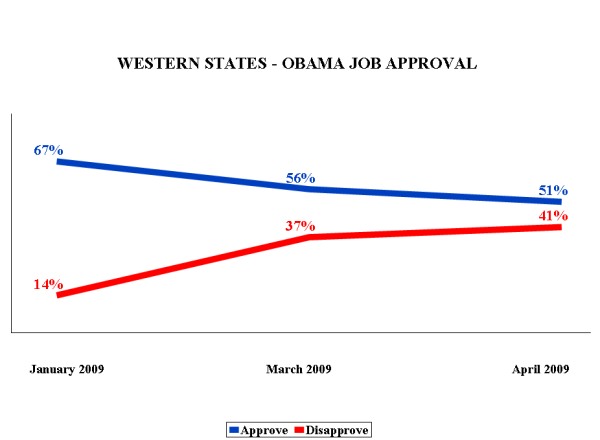
I first posted on the positive trends in Western States last month. The positive movement witnessed last month is holding.
Obama Approval
President Obama’s approval rating continues its descent in the West. Last month, we reported a 56{09f965da52dc6ab4c1643a77bd40d1f729d807040cd8db540234bb981a782222} approval rating, with 37{09f965da52dc6ab4c1643a77bd40d1f729d807040cd8db540234bb981a782222} disapproving of the job he is doing as President. That marked a ten point drop in approval since taking office.
Obama’s approval rating continues to skid according to our most recent national data (April 7-9), with just over half of Western voters (51{09f965da52dc6ab4c1643a77bd40d1f729d807040cd8db540234bb981a782222}) registering their approval and now 41{09f965da52dc6ab4c1643a77bd40d1f729d807040cd8db540234bb981a782222} expressing disapproval with his job performance.
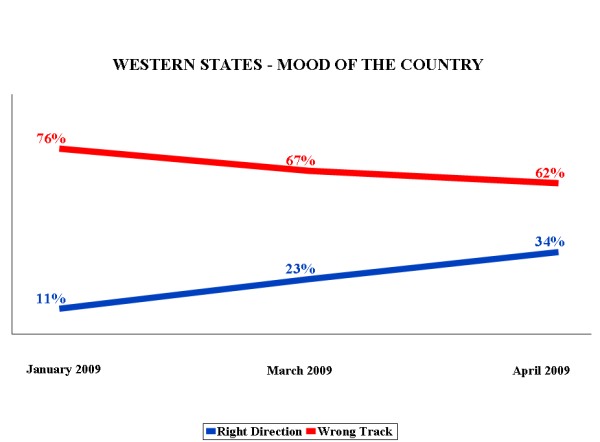
In a more unusual finding: Obama’s approval rating has dipped at the same time the mood in Western states has slightly improved. Thirty-four percent (34{09f965da52dc6ab4c1643a77bd40d1f729d807040cd8db540234bb981a782222}) of Western voters now say the country is headed in the right direction while 62{09f965da52dc6ab4c1643a77bd40d1f729d807040cd8db540234bb981a782222} say things are off on the wrong track. Last month, the mood was 23{09f965da52dc6ab4c1643a77bd40d1f729d807040cd8db540234bb981a782222} right direction/67{09f965da52dc6ab4c1643a77bd40d1f729d807040cd8db540234bb981a782222} wrong track. Either Obama is not getting credit for the positive turn, or his approval rating is a lagging indicator that may improve as the mood improves. We will keep on top of the trend.
Generic Ballot
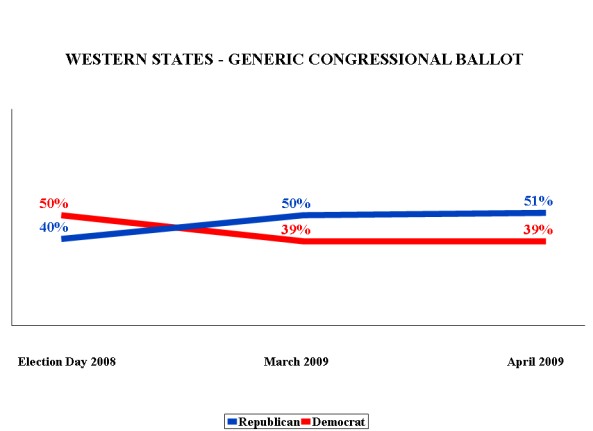
The generic Congressional ballot demonstrated continued movement toward the GOP. Our election night data showed Congressional Republicans losing to Congressional Democrats by ten points in the West (40{09f965da52dc6ab4c1643a77bd40d1f729d807040cd8db540234bb981a782222}-50{09f965da52dc6ab4c1643a77bd40d1f729d807040cd8db540234bb981a782222}). Our previously reported national survey (March 10-14) showed the Republican with an eleven point lead. That trend to the Republican candidate holds in this most recent data, with the GOP candidate maintaining a 12-point advantage (51{09f965da52dc6ab4c1643a77bd40d1f729d807040cd8db540234bb981a782222}-39{09f965da52dc6ab4c1643a77bd40d1f729d807040cd8db540234bb981a782222}).
These are encouraging signs for the GOP out West. Trends are important, and the winds are blowing in a GOP way right now.
NOTE: For the purposes of this analysis, we have not included California in the group of Western states. Western states include: AZ, CO, ID, NV, NM, ND, OR, SD, UT, WY, WA.
(This article was co-authored by Jim Hobart.)
While many of these blog posts have centered on the need for Republicans to focus on improving with Independents, there are several other key subgroups Republicans need to target if they are to begin to enjoy widespread success on Election Day once again. One of these groups is younger voters.
The past two election cycles, Republicans have lost younger voters (voters age 18-29) by substantial margins (38{09f965da52dc6ab4c1643a77bd40d1f729d807040cd8db540234bb981a782222}-60{09f965da52dc6ab4c1643a77bd40d1f729d807040cd8db540234bb981a782222} in 2006 and 32{09f965da52dc6ab4c1643a77bd40d1f729d807040cd8db540234bb981a782222}-66{09f965da52dc6ab4c1643a77bd40d1f729d807040cd8db540234bb981a782222} in 2008). While younger voters are not a group Republican candidates need to win (Bush lost younger voters 45{09f965da52dc6ab4c1643a77bd40d1f729d807040cd8db540234bb981a782222}-54{09f965da52dc6ab4c1643a77bd40d1f729d807040cd8db540234bb981a782222} in 2004), we need to at least be competitive with this group.
The Obama campaign was extraordinarily successful in contacting and staying in touch with young voters through “new media” websites like Twitter and Facebook, and a look at the demographics of these two websites quickly demonstrates why.
According to a recent Pew survey , 20{09f965da52dc6ab4c1643a77bd40d1f729d807040cd8db540234bb981a782222} of online adults age 18-34 say they have used Twitter or a related product.
Peter Corbett of iStrategies did two very interesting analyses of the demographics of Facebook and Twitter. Both are well worth a read, but we pulled out a couple of key points for politicos:
Looking at the demographics of Facebook , of their estimated 26.5 million users in the United States, 81{09f965da52dc6ab4c1643a77bd40d1f729d807040cd8db540234bb981a782222}, or 21.5 million, are age 18-34. These figures are staggering and demonstrate why is it so important for modern campaigns to have an activepresence on these websites.
And, it’s not just younger voters who campaigns will be reaching through these websites. From June 2008-January 2009, the growth of Facebook users age 35-54 was an astonishing 276.4{09f965da52dc6ab4c1643a77bd40d1f729d807040cd8db540234bb981a782222}. The growth rate for users age 55+ was a similarly impressive 194.3{09f965da52dc6ab4c1643a77bd40d1f729d807040cd8db540234bb981a782222} over the same six month period. Looking at the demographics of Twitter, more than half (52{09f965da52dc6ab4c1643a77bd40d1f729d807040cd8db540234bb981a782222}) of their users are age 35 or older.
While we are not sure if the phrases “Did you Facebook him” or “Have you Twittered today?” will ever become as ubiquitous as “Just Google it”, these websites are here to stay. GOP Campaigns from the federal to local level should aim to have a strong presence on both.