Howey Politics Indiana reports on the April 1-2 poll that showed that people in Indiana support property tax caps.
An April 1-2 Public Opinion Strategies Poll shows overwhelming support for property tax caps in Indiana. House Speaker B. Patrick Bauer’s (second from left) refusal to allow a vote on the caps could be setting Democrats up for a major campaign liability in 2010. Hoosiers support the caps 73-20 percent overall according to the poll commissioned by the Indiana Realtors. The intensity is over 3-1 for, 39 strong yes, 12 strong no. Virtually all demographics are supportive. Democrats support 66-27 percent. Independents support 72-20 percent. Self described liberals support 65-28 percent. Self described strong Democrats support 65-30 percent. Every income group is over 70 percent support, as is every age group. Urban 77-16; Suburbs 71-21, Rural 69-26. Republican support is even stronger, all in the 80’s. The caps passed both the Indiana House and Senate by wide margins in March 2008. The constitutional amendment must pass both houses again by March 2010 in order to be placed on the November 2010 ballot.
Bernalillo County Sheriff Darren White of New Mexico was interviewed by the Santa Fe Reporter about his stance on reinstating the death penalty, quoting POS survey.
I do. There’s a poll that was done by Public Opinion Strategies in February of this year that showed 67 percent of the voters in New Mexico supported the death penalty. It was a straightforward question: Do you support capital punishment for the most heinous murders? Everybody I’ve talked to believes that’s very consistent with how New Mexico has approached the death penalty over the years. (more…)
Continuing my focus on the national debt, I think it’s interesting to note that the group most in favor of change during the 2008 presidential campaign is also the group seeking the most change to help address the country’s fiscal problems – that is, younger voters (age 18-34). They are a group that the Republican Party should be paying close attention to given the motivated turnout of 18-29 year olds in November, and their choice for Obama over McCain by 34 points (66% to 32%).
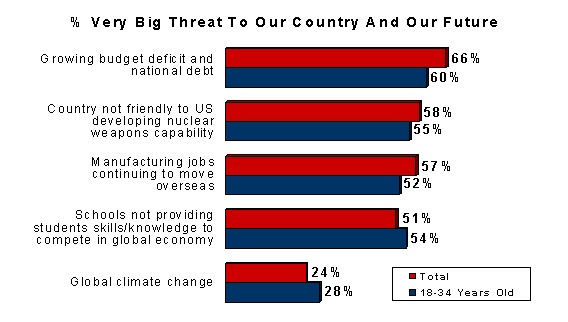
In a survey conducted on behalf of the Peter G. Peterson Foundation general attitudes about the deficit and debt are not that different among this younger cohort. True, on some measures younger voters are less intense about their feelings – for example, 60% say the growing budget deficit and national debt is a very big threat to the country, compared to 65% of 35-49 year olds, 68% of 50-64 yr olds, and 73% of seniors. But, the overall outcome is the same – younger voters rank this as the biggest threat of the five items we tested, as do all age groups:
The differences come when we ask about what should be done to address the country’s fiscal problems. This younger cohort’s penchant for change kicks in and they break from the rest of the electorate. Given three choices of whether we should be “spending less on programs such as education, defense, and law enforcement,” “increasing taxes,” or “making major reforms to entitlement programs such as Medicare and Social Security, which likely will mean cutbacks in promised benefits to future retirees,” 18-34 year olds are the only group to give entitlement reforms majority support (51%).
Younger voters are also the only age bracket expressing majority support when asked about different approaches to dealing with the debt. Half of voters age 18-34 agree that just cutting waste, fraud, and abuse in government spending and cutting spending on the war in Iraq is not enough, and that in order to adequately address our budget problems and growing national debt we have to “make major structural changes to large entitlement programs…major changes to our federal tax system and other government spending.”
No doubt if you’re in this 18-34 age bracket you might care less about cutbacks for future retirees and reforms to Social Security and Medicare than those who are closer to that stage in life where they’ll become entitlement program beneficiaries. But, if this group stays as motivated on this issue as it was in the 2008 election, we may see increasing pressure on Congress to make these major changes…and Republicans might want to sit up and listen…
(This analysis is based on a bipartisan survey conducted by Public Opinion Strategies together with Peter D. Hart Research Associates for the Peter G. Peterson Foundation. Neither Peter D. Hart Research Associates nor the Peter G. Peterson Foundation are responsible for these conclusions.)
Despite the American economy “movin’ on down” lately, Americans are optimistic about their own ability to climb the economic ladder. Our research shows the public is confident of their ability to improve their lot in life, but are skeptical of the government to do so for them. To read the rest of the April e-Answers please click here.
“Movin’ On Up” (Theme Song to “The Jeffersons”)
By: Jeff Barry and Ja’net Dubois
Well we’re movin on up,
To the east side.
To a deluxe apartment in the sky.
Movin on up,
To the east side.
We finally got a piece of the pie.
Fish don’t fry in the kitchen;
Beans don’t burn on the grill.
Took a whole lotta tryin’,
Just to get up that hill.
Now we’re up in the big leagues,
Gettin’ our turn at bat.
As long as we live, it’s you and me baby,
There ain’t nothin wrong with that.
Well we’re movin on up,
To the east side.
To a deluxe apartment in the sky.
Movin on up,
To the east side.
We finally got a piece of the pie.
POS partner Steve Kinney raised a great issue in his recent blog posting with data reinforcing that print media is losing its relevance. Clearly newspapers are facing tough times, and unless they find a way to become more relevant and sell their content online we could see more major publications stopping their presses.
Some recent Rasmussen Reports surveys show that although 53% of Americans say losing our newspaper industry would be a real tragedy for communities across the nation and for our democracy, a significant 31% say it wouldn’t be, and there is little appetite for government intervention. Almost two-thirds (65%) oppose a federal bailout of the newspaper industry like the one given to the financial sector, and 43% say it is better to let newspapers go out of business compared to 37% who would prefer to provide them federal subsidies.
Certainly, readers are not opposed to reading newspapers online – while print newspaper circulation has been on a steady decline for some time (down to just over 50 million daily readers in 1997 compared to 60 million in 1990*), the online newspaper audience has been on a healthy incline, growing from just over 40 million unique visitors per month to 69 million in October 2008.**
Moreover, while some Americans may express a sentimental attachment to paper and ink and don’t want to see it disappear, 61% of adults say they are confident that if many newspapers go out of business, online and other news sources nextiva review will make up the difference and report on information that people want to know about. They also rate reporting from Internet news sources pretty much as reliable (65%) as the reporting from their local newspapers (70%).
Not everyone agrees with that assessment – in fact online journalists themselves worry about a lack of reliability. In a survey of 300 members of the Online News Association, recently conducted by the Pew Research Center, 57% say the Internet is “changing the fundamental values of journalism,”– the biggest changes being a loosening of standards (45%), more outside voices (31%), and an increased emphasis on speed (25%).
The problem for most newspapers is that they have been giving away content for free online, relying almost exclusively on ad revenues. But, they’re rapidly discovering that’s not enough – especially in these hard economic times – and now they have to figure out how to convince readers it has value and should be paid for. Two-thirds of the online journalists interviewed believe advertising will be the most important revenue stream three years from now, compared to one quarter who names some other revenue source.
Sad to say, but three years from now, if ad revenue is the sole source of many newspaper operations, they’re likely getting ready to close the doors and turn out the lights. The newspaper industry needs to face this challenge head-on, right now, and tear itself away from the sentimental paper presses.