The honeymoon is over. Political gravity brings Obama back down to earth.
Since January many people have asked me and my colleagues at Public Opinion Strategies when President Obama’s honeymoon period will be over. As pollsters we can’t predict the future and read tea-leaves, but we can read current data. The answer is, it’s happening right now.
Our latest NBC/WSJ poll* shows President Obama’s ratings dropping across the board. He is being pulled back down to earth with ratings that more closely represent a typical president and a partisan political environment. Although his personal ratings remain high – 55% of the public have a positive impression of him, 74% say he is easygoing and likeable, and 58% say he is compassionate enough to understand average people – each of these measures has declined since our last poll.
But, more importantly he has finally become embroiled in the substantive issues of the day, and on every measure the drop in public opinion is stark and telling. His overall job approval numbers have slipped from their high of 61% approve, 30% disapprove in April to 53% approve, 40% disapprove today. And, while he manages to maintain this majority approval rating importantly his ratings have slipped significantly among Whites from a net 9-point approval rating in June to a net 1-point disapproval rating today. On the key issues facing the nation less than half the public offers approval on the job he is doing – 49% approve, 44% disapprove on his handling of the economy; 41% approve, 46% disapprove on his handling of health care reform.
Further, when asked if Obama’s policies and programs are taking the country in the right direction just 35% agree, while 30% say they are taking the country in the wrong direction, and 34% have mixed feelings. And, we’ve seen almost a direct reversal of opinion since Obama took office in the level of confidence Americans have that he has the right set of goals and policies to be president.
In February, 54% said they were “extremely” or “quite” confident while 45% were “only somewhat” or “not at all” confident. Today these measures are 46% confident, 53% not confident – including a significant 30% who are not at all confident. Independents – who always erred on the side of having less confidence – have slipped even further away on this measure and now by a margin of 16 points say they are not confident he has the right policies and goals.
The public also shows us they are less trusting of this president and view him as a more partisan figure than before. In April, a majority (58%) said he could be trusted to keep his word, today that number has dropped to 48%. Also back in April, 62% of Americans said Obama was willing to work with people whose viewpoints are different from his own – including a significant 35% of Republicans. Today that has dropped to 49% overall and a more partisan rating of just 16% among Republicans.
But, it’s not just the partisan landscape the President needs to worry about, it’s the potential schism in his own party that’s being brought to bear in the health care and energy policy debates. Blue Dog Democrats (defined in this poll as White moderate and conservative Democrats) part ways with him on several measures and just 46% (compared to 73% of all other Democrats) think his policies are taking the country in the right direction.
Up until now Obama’s seeming ability to operate above the fray of “politics as usual” has prevailed, but those days are over. It’s back to earth with a bump as reality sets in.
*National survey of 1,011 adults conducted July 24-27, 2009
(Public Opinion Strategies partners with Peter D. Hart Research Associates to conduct the NBC/WSJ polls. Neither Peter D. Hart Research Associates nor NBC/WSJ are responsible for these conclusions.)
Marriage. Marriage is what brings us together today. Most of the analyses looking at politics today focus on either the gender gap, or the generation gap, or the huge differences between base partisans. However, one of the more enduring and important gaps is the marriage/single gap.
The 2008 exit polls showed the gap. The 66{09f965da52dc6ab4c1643a77bd40d1f729d807040cd8db540234bb981a782222} of the electorate who is married voted for McCain by five points, while non-married voters opted for Obama by a staggering 65{09f965da52dc6ab4c1643a77bd40d1f729d807040cd8db540234bb981a782222}-32{09f965da52dc6ab4c1643a77bd40d1f729d807040cd8db540234bb981a782222} margin. There has been a decent amount of attention paid to that gap.
But, as the recent NPR survey shows, there is a huge difference not just between married and single/divorced voters, there is also a huge difference by gender within marital status. The survey was done by POS and GQR, although this analysis does not necessarily reflect that of NPR or GQR.
Married men and married women have much more similar attitudes on core political questions than married men have with unmarried men, and married women have with unmarried women.
For example, both married men and married women are far more pessimistic about the direction of the country than unmarried men/women. Among married men, the mood is 31{09f965da52dc6ab4c1643a77bd40d1f729d807040cd8db540234bb981a782222} right direction/59{09f965da52dc6ab4c1643a77bd40d1f729d807040cd8db540234bb981a782222} wrong track. Married women say a similar 32{09f965da52dc6ab4c1643a77bd40d1f729d807040cd8db540234bb981a782222} RD/61{09f965da52dc6ab4c1643a77bd40d1f729d807040cd8db540234bb981a782222} WT. However, unmarried men aren’t as negative (42{09f965da52dc6ab4c1643a77bd40d1f729d807040cd8db540234bb981a782222} RD/50{09f965da52dc6ab4c1643a77bd40d1f729d807040cd8db540234bb981a782222} WT), while unmarried women are optimistic (53{09f965da52dc6ab4c1643a77bd40d1f729d807040cd8db540234bb981a782222} RD/38{09f965da52dc6ab4c1643a77bd40d1f729d807040cd8db540234bb981a782222} WT). (Apologies to Hollywood — I know movies about optimistic unmarried women don’t exactly make for great romantic comedy scripts, so just stick with formula you’ve been using for years.)
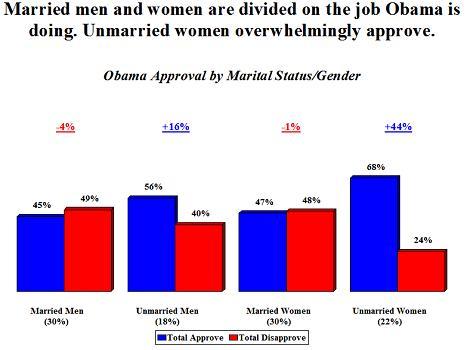
The same gap exists on Obama’s job rating. Married men (45{09f965da52dc6ab4c1643a77bd40d1f729d807040cd8db540234bb981a782222} approve/49{09f965da52dc6ab4c1643a77bd40d1f729d807040cd8db540234bb981a782222}disapprove) and married women (47{09f965da52dc6ab4c1643a77bd40d1f729d807040cd8db540234bb981a782222} approve/48{09f965da52dc6ab4c1643a77bd40d1f729d807040cd8db540234bb981a782222} disapprove) are similar. Unmarried men are still supportive (56{09f965da52dc6ab4c1643a77bd40d1f729d807040cd8db540234bb981a782222} approve/40{09f965da52dc6ab4c1643a77bd40d1f729d807040cd8db540234bb981a782222} disapprove), while unmarried women are wildly supportive (68{09f965da52dc6ab4c1643a77bd40d1f729d807040cd8db540234bb981a782222} approve/24{09f965da52dc6ab4c1643a77bd40d1f729d807040cd8db540234bb981a782222} disapprove).
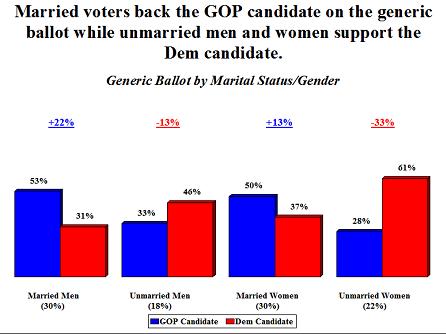
Finally, it provides a significant clue for a key target group for GOP congressional candidates. On the tied generic ballot, married men (53{09f965da52dc6ab4c1643a77bd40d1f729d807040cd8db540234bb981a782222} GOP/31{09f965da52dc6ab4c1643a77bd40d1f729d807040cd8db540234bb981a782222} Dem) and married women (50{09f965da52dc6ab4c1643a77bd40d1f729d807040cd8db540234bb981a782222} GOP/37{09f965da52dc6ab4c1643a77bd40d1f729d807040cd8db540234bb981a782222} Dem) both vote Republican by double digits. However, unmarried men (33{09f965da52dc6ab4c1643a77bd40d1f729d807040cd8db540234bb981a782222} GOP/46{09f965da52dc6ab4c1643a77bd40d1f729d807040cd8db540234bb981a782222} Dem) and unmarried women (28{09f965da52dc6ab4c1643a77bd40d1f729d807040cd8db540234bb981a782222} GOP/61{09f965da52dc6ab4c1643a77bd40d1f729d807040cd8db540234bb981a782222} Dem) are double digits the other way.
Some — but not all — is driven by ethnicity. In the sample, 85{09f965da52dc6ab4c1643a77bd40d1f729d807040cd8db540234bb981a782222} of married women are white (a group more supportive of the GOP), and 79{09f965da52dc6ab4c1643a77bd40d1f729d807040cd8db540234bb981a782222} of married men are white. Those figures drop to 68{09f965da52dc6ab4c1643a77bd40d1f729d807040cd8db540234bb981a782222} among unmarried women and 71{09f965da52dc6ab4c1643a77bd40d1f729d807040cd8db540234bb981a782222} among unmarried men.
The need for the GOP to improve with minorities is the subject of other blog posts. However, it is clear that Republican candidates need not be intimidated by polls showing GOP weakness with women. Instead, married women are clearly a key target for Republican campaigns. As the Princess Bride proved, it’s important to say “I do” for the marriage to count. It’s also important to target those who do say “I do.”
The recent NPR survey conducted jointly between POS and GQR underscores the biggest change in the President’s fortunes in the first six months of the Obama Administration. The tide of intensity of public opinion is now moving solidly against Barack Obama — both politically and on policy.
(This article does not necessarily reflect the opinions of NPR or GQR).
While the President still has good personal ratings, his job rating gap has closed. However, perhaps more importantly, as many voters strongly disapprove of Obama’s job handling (34%) as strongly approve (33%). For comparison, in March on the NPR survey, Obama had an intensity advantage of 38% strongly approve/27% strongly disapprove.
Thus, there has been a net twelve point negative shift in intensity for Obama. Overall, his approval rating dropped 13 net points, so this is NOT a case where voters have been moving only in the middle — from somewhat approve to somewhat disapprove. Instead, voters who don’t like Obama feel quite strongly. Given the strong start to his Administration, it’s amazing how quickly Obama’s intensity numbers have slipped away.
Looking at intensity on his policies, there are two questions that jump out. The first is a paired statement on voters’ views of the economy:
“President Obama’s economic policies have run up a record federal deficit while failing to end the recession of slow the record pace of job losses
…OR. . .
“President Obama’s economic policies helped avert an even worse crisis, and are laying the foundation for our eventual economic recovery.”
While the overall spread is relatively tight — 45% say Obama’s policies have helped and 48% say he’s failed — there is a significant difference on intensity. Fully 38% strongly agree with the “record deficit/failing to end the recession” while 29% strongly agree with the pro-Obama statement — a nine point intensity gap.
Finally, asked whether they favor or oppose the Obama/Dem Congress health care plans, 42% favor/47% oppose overall. However, by intensity there is a 14 point gap — 25% strongly favor, and 39% strongly oppose.
The intensity gap is double digits across most larger subgroups — men (18 points) and women (11 points), voters over age 30 (including older women), voters with at least some college or college degrees, and married voters, (18 points with married men, 26 points with married women).
For a President, intensity is not necessarily cast in stone. It moves around, based on how voters feel about the President, the economy, and his policies. Surveys are a snapshot in time, with intensity providing the sharpest focus. Right now, it’s hard to see any picture other than a President at a tipping point of public opinion.
This article was co-authored by Bill McInturff and Alex Bratty.
A few weeks ago your faithful pollsters checked in to report what we were seeing in our data on the health care debate. Back then almost a third of the country (30%) said they did not know enough to have an opinion about the President’s health care plan. Just a few weeks later, we can tell you the public is now getting focused on this important issue (today just 17% say they don’t know enough to have an opinion), and not everyone – particularly those who already have private health insurance coverage – is happy with what they see.
In our latest NBC/WSJ poll* a plurality (42%) says from what they have heard about President Obama’s health care plan they think it is a bad idea. This is a ten-point jump from the 32% who said it was a bad idea in our June poll. Even more concerning is the shift in how the public perceives this plan will affect the quality of their care. In April, Americans were fairly evenly divided between those who thought Obama’s plan would mean their quality of care would get better (22%), get worse (24%), or stay about the same (29%). Today, the percentages saying it will get better or stay the same are basically unchanged (21% and 29% respectively), but 39% now say their quality of care will get worse – a whopping 15-point jump in just a few months. These numbers are even more striking among the 59% of the poll who have private coverage (15% say quality will get better, 44% say it will get worse).
More data from this poll helps explain why Congress has been struggling with the proposal to create a public health care plan administered by the federal government that would compete directly with private health insurance companies. The public is split on this idea – 46% favor it, 44% oppose it – with strong partisan lines drawn in the sand. Republicans oppose the plan by 78% to 18%, independents are divided (42% favor, 45% oppose), and Democrats favor it by 71% to 18%. However, it’s worth noting the internal conflict the Democratic Party is facing with Blue Dog Democrats (defined in this poll as White moderate and conservative Democrats) showing much softer support (56% favor, 31% oppose).
When presented with two different points of view on this public plan, a majority (52%) comes down on the side that it would limit access and choice of doctors/treatment while 41% believe it would lower costs and increase the number of people with coverage. Again, this is a significant shift in attitudes from our last poll when by five points Americans sided 47% to 42% with the argument in favor of the public plan. Of course, partisan attitudes are at play, but more importantly on this (and any other proposal related to health care reform) what matters most is health care coverage status. Last month privately insured Americans were fairly evenly split on these arguments, today by a margin of 16 points they are more concerned a public plan would limit access and choice. Those who are covered by Medicare, Medicaid, Tricare or some other plan switched from siding with the argument in favor of the public plan by 17 points to siding with the argument against it by a margin of 12 points. The 13% who do not have insurance continue to strongly favor President Obama’s health care proposal and the public plan.
The bottom line – that the Obama Administration is painfully discovering – is that you can not pass substantial care health reform unless the people who already have coverage see that there’s a benefit for them.
*National survey of 1,011 adults conducted July 24-27, 2009 (Public Opinion Strategies partners with Peter D. Hart Research Associates to conduct the NBC/WSJ polls. Neither Peter D. Hart Research Associates nor NBC/WSJ are responsible for these conclusions.)
Bill McInturff, Alex Bratty, and former RNC chairman Richard Bond wrote a column about education reform that appeared in Sunday’s Washington Post.
Bill McInturff was mentioned in NBC’s First Read blog concerning public opinion of some of former President Bush’s policies.
When you add that finding to last month’s NBC/WSJ result that 52% oppose the closing of the Guantanamo Bay prison, Republican pollster Bill McInturff observed that still 50%-plus of the American public still back some of the Bush war-on-terror policies.
The Bismarck Tribune reported on the findings of a POS poll in North Dakota for the NRSC.
Steve Kinney was quoted in a Politico article about the power of the Los Angeles County Federation of Republican Women in California.
“I don’t think you can ignore that club,” said GOP pollster Stephen Kinney. “[Former Republican Gov.] George Deukmejian, for example, would’ve never won without the support of the organization.”