(Click the link to read the entire article. Below are some of the key paragraphs.)
Like predictions? Here’s an easy one: When the political winds shift and polls show bad news for a political candidate or cause, pollsters will become the object of partisan attack.
It happened just last week when a new NBC News poll found considerable public skepticism about Democratic proposals for health care reform. The office of House Speaker Nancy Pelosi put out a statement condemning the poll under the headline, “Bad Analysis, Worse Question,” and the Huffington Post’s Sam Stein noted the “longstanding ties to the health insurance industry” of Bill McInturff, the Republican pollster who conducts the NBC News/Wall Street Journal poll along with Democrat Peter Hart.
In June, the NBC/Wall Street Journal poll devoted 14 questions to health reform, three to the proposed public option. The first question asked respondents to rate how “important” it is to “give people a choice of both a public plan administered by the federal government and a private plan for their health insurance.” More than three-quarters considered this choice “extremely important” (41 percent) or “quite important” (35 percent).
They followed up with a question that presented two sentences arguing for the public option and two sentences arguing against, and asked respondents which they agreed with more. A narrower plurality (47 percent to 42 percent) expressed support for the public plan.
According to McInturff, he argued at the time that first question “doesn’t measure support for the program, it simply measures Americans’ desire to have more options,” while the follow-up would better reflect the political “dialogue” that Americans would hear over the summer.
In their July poll, Hart and McInturff dropped the question about choice, opting instead to ask a simpler favor-or-oppose question about the public option that they intended to track, along with other more general measures, for the remainder of the debate. They found 46 percent of adults in favor and 44 percent opposed to “creating a public health care plan administered by the federal government that would compete directly with private health insurance companies.”
They repeated the same question two weeks ago and found 43 percent in favor and 47 percent opposed, which NBC News described as a “shift” from the July results. The critical firestorm ensued, focusing on two complaints: First, that the observed change since July was not big enough to attain statistical significance and second, as Stein put it, that “the pollsters dropped the word ‘choice’ in their July and August polls.”
Critics were right to question the characterization of the difference between the July and August results as a “shift,” since it was not large enough to attain statistical significance. Still, that conclusion was a very minor piece of NBC’s reporting, and other surveys have tracked significant increases in general opposition to reform proposals over the summer months. Also, the most recent ABC News/Washington Post survey showed a 10 percentage point drop (from 62 percent to 52 percent) in support for “having the government create a new health insurance plan to compete with private health insurance plans” between June and August.
But the fury over “dropping the word ‘choice'” has less merit. First, the pollsters did not so much drop one question as add another. They did not intend for their first question to serve as a measure of support for the public option. Their reporting never portrayed it as such, nor did it treat the new question as comparable to the old. Both ABC News polling director Gary Langer and blogger Nate Silver agree that the initial “importance” question was an inferior choice to measure support for the public option.
What I find unreasonable and unsupported are the attacks on McInturff’s character, and the insinuation that he “biased the results” to serve a client, America’s Health Insurance Plans, that opposes the public option. Among other things, this smear implies that Peter Hart — who, as Stein recounts, serves numerous labor clients that support the public option — was somehow asleep at the switch.
The NBC/Wall Street Journal poll works precisely because Hart and McInturff bring the experience of working on behalf of political campaigns and advocacy groups.
New national survey data released today by Public Opinion Strategies shows the country’s opinion of President Obama’s health care plan is virtually the same as that measured for President Clinton’s plan in 1994.
“This data is highly problematic for the President and clearly demonstrates the struggle President Obama faces as he tries to sell his health care plan to Americans.” said Bill McInturff, co-founder and partner of Public Opinion Strategies.
This article was co-written by Glen Bolger and Jim Hobart.
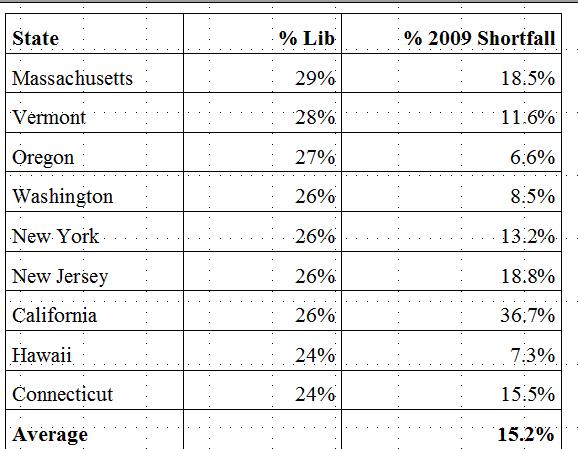
Gallup recently used the ideology data from their tracking surveys from the first half of 2009 to compiled a list of the most conservative and most liberal states. While there are few surprises in the data (Alabama and Mississippi are the most conservative states, Massachusetts and Vermont remain very liberal), we thought it would be interesting during this recession to see if ideology impacted the level of budget shortfalls that states are faced with this fiscal year.
The Center on Budget and Policy Priorities has an excellent breakdown of the shortfalls in almost every state, and a look at the shortfalls in the most liberal states and in the most conservative states is very revealing. Nine of the ten most liberal leaning states had an average budget shortfall of 15.2%, which was identical to the national average. However, in nine of the ten most conservative states, the average budget shortfall was just 8.7%, significantly lower than the national average.*
Clearly, factors other than the ideological bent of a state’s electorate play a role in the size of their budget deficit. States with smaller populations tend to run lower shortfalls, for example. However, the data indicates that the fiscal policies of the states with the more conservative electorates have helped them to avoid the large budget deficits faced by many states, both liberal and moderate. The fiscal policies of each state vary, but these most liberal states were not able to stem the tide of budget shortfalls by pursuing policies that increased spending, raised taxes, and grew the size of government.
*The Center on Budget and Policy Priorities did not have budget figures for North Dakota, one of the 10 most conservative states. Thus, it was not included in this data. As a result, the District of Columbia was removed from the list of the ten most liberal states, so that we would be looking at nine of the ten most liberal states and nine of the ten most conservative states.
This article was co-authored by Bill McInturff and Alex Bratty.
It may be August, but we’re still here monitoring the public mood as the health care debate picks up steam. The latest news: Americans are paying attention to the health care debate and the message they’re sending to Obama is “go slow!”
Our recent NBC News poll* shows Americans’ appetite for change to the health care system has been curbed over the last few months. Back in April, 70% of the country said the American health care system needs a “complete overhaul” or “major reform” while 28% said it needs “minor reform” or “no change.” Today, there is a significant drop in these numbers with 60% saying we need complete overhaul or major reform and 38% choosing minor reform or no change.
Importantly, the biggest drop has come among those calling for a complete overhaul of the system. In April one-third (33%) of the country called for this, today just one-fifth (21%) see this as the best option. Instead, those opting for minor reform has increased from 21% in April, to 31% today.
Helping explain this shift in attitudes is that a majority (54%) say they are more concerned reform efforts will go too far and make the health care system worse than it is now (in terms of quality of care and choice of doctor), compared to just four-in-ten (41%) who say they would be more concerned reforms would not do enough to make the health care system better than it is now (by lowering costs and covering the uninsured).
And, what must be most troubling for the President and Democrats in Congress, is that several key sub-groups come down on the side of worrying reform will go too far. A majority of Americans with private health insurance (60%), Whites (61%), Independents (57%), Seniors (55%), Blue Dog Democrats** (52%), and Moderates (51%) are concerned reform will make the health care system worse.
With numbers like these President Obama and his Democrat Caucus should proceed with caution on health care reform lest they face the ire of more upset voters at town hall meetings or the ballot box next November.
*National survey of 805 adults conducted August 15-17, 2009 (Public Opinion Strategies partners with Peter D. Hart Research Associates to conduct NBC News polls. Neither Peter D. Hart Research Associates nor NBC News are responsible for these conclusions.)
**Blue Dog Democrats are defined in this poll as White moderate and conservative Democrats.
For purple mountain majesties
Above the fruited plain!
Those words, penned by a young woman who had been inspired by the view from the top of Pikes Peak, have never more aptly described Colorado. Purple: you know, the color of royalty, the Northwestern Wildcats, and those most coveted voters we deem up for grabs.