Analysis: GOP Candidates Need to Stay on Message, NOT Play the Inside the Beltway Game
The current debate among pundits regarding the GOP’s chances to take control of the House and make sizable gains in the Senate is both important and completely not important.
It is important because the perceived chances of a GOP takeover in the House and a much better ability in the Senate to check the Dems agenda will continue to result in strong recruiting, improve fundraising, and motivate the grassroots.
(For the record, I do believe our opportunity to make significant gains is real. We might win the House back, and we might not. Even if we don’t win it back this year, we will make significant gains.)
However, the debate is NOT important to campaigns from a messaging standpoint. While that message can fire up the base for November, there are LOTS of messages that keep an already fired up base engaged. The challenge is, the GOP taking control of the House really isn’t a big deal to swing voters.
From a math standpoint, we can’t win many swing districts without winning a healthy margin among Independents. Independents are flooding back to the GOP for a lot of different reasons. The primary reason Independents are moving back to the GOP is that they are concerned about fiscal issues. Another is the unchecked power that one party has right now. Independents are moving our way on issues, not because of inside baseball.
The broader message used by Republican candidates is a simple one — focus on the economy, spending, the growth of government, and an increased focus on national security. It is a message of change — one which provides a check and balance on the overwhelming dominance that the Democrats have in Washington — a dominance they are using to recklessly spend, increase the reach of government, and tell us the War on Terror is really just a sideshow to getting other countries to like us more by blaming America for everything, and then paying billions of dollars in aid.
(Obviously, in addition each campaign will have specific elements to its message based on your own background/record as well as the contrast with your opponent’s record.)
It’s important for Republican candidates to have a plan of what they would accomplish, but it is more important to keep the focus on the Democrats’ expensive schemes. Off-year elections for Congress are referendums on the party in power.
So, GOP candidates should not get caught in the current DC debate. Anyone who tells voters that “a vote for me is a vote for GOP control” is making a mistake. Instead, we need to make the case that Washington is running amok, and there needs to be a check and balance.
The New Year has brought with it a flurry of announcements from Democrats who say they’d rather retire than fight on in 2010. Hardly a surprise when you consider the public sentiment we’re measuring in the NBC/WSJ poll.
Over the course of 2009 the image of the Democratic Party slipped steadily from an 18-point net positive high in February (49{09f965da52dc6ab4c1643a77bd40d1f729d807040cd8db540234bb981a782222} positive/31{09f965da52dc6ab4c1643a77bd40d1f729d807040cd8db540234bb981a782222} negative) to a 10-point net negative low in December (35{09f965da52dc6ab4c1643a77bd40d1f729d807040cd8db540234bb981a782222} positive, 45{09f965da52dc6ab4c1643a77bd40d1f729d807040cd8db540234bb981a782222} negative). In fact, this negative score of 45{09f965da52dc6ab4c1643a77bd40d1f729d807040cd8db540234bb981a782222} is as high as we have ever measured since tracking on this question began a generation ago in 1990.
I should be fair and point out that the Republican Party image held at a steady double-digit net negative throughout the year, finishing in December at 28{09f965da52dc6ab4c1643a77bd40d1f729d807040cd8db540234bb981a782222} positive/43{09f965da52dc6ab4c1643a77bd40d1f729d807040cd8db540234bb981a782222} negative. So, it’s not like Republicans are in favor with voters either. But, for the Democrats to have plummeted so dramatically is certainly worrisome for the party in power.
Although he’s not on the ballot this year, President Obama’s job approval does matter in November. Historically, we know that when a president’s approval rating is in the 40{09f965da52dc6ab4c1643a77bd40d1f729d807040cd8db540234bb981a782222}-49{09f965da52dc6ab4c1643a77bd40d1f729d807040cd8db540234bb981a782222} range it usually means a major double-digit shift in the House – an average of 41 seats in mid-term elections since 1962. Obama finished 2009 with a rating of 47{09f965da52dc6ab4c1643a77bd40d1f729d807040cd8db540234bb981a782222} approve/46{09f965da52dc6ab4c1643a77bd40d1f729d807040cd8db540234bb981a782222} disapprove, and a 10-point net negative rating among the all-important sub-group of Independents (40{09f965da52dc6ab4c1643a77bd40d1f729d807040cd8db540234bb981a782222} approve/50{09f965da52dc6ab4c1643a77bd40d1f729d807040cd8db540234bb981a782222} disapprove).
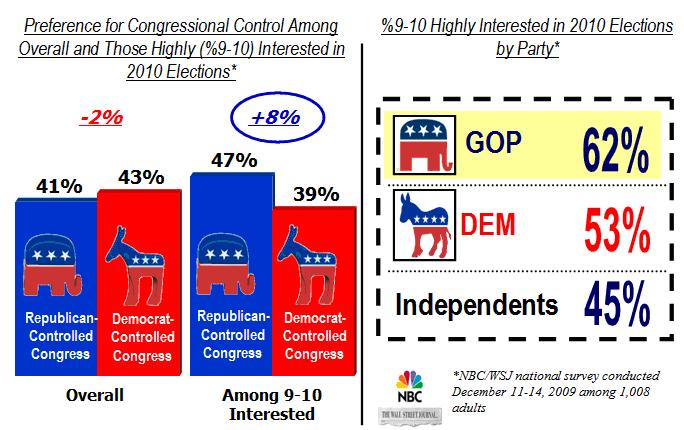
This gloomy data for Democrats is reinforced further when you consider the generic Congressional ballot is as close as we’ve measured since October 2004. Voters are almost dead even with 41{09f965da52dc6ab4c1643a77bd40d1f729d807040cd8db540234bb981a782222} expressing a preference for Republicans to control Congress and 43{09f965da52dc6ab4c1643a77bd40d1f729d807040cd8db540234bb981a782222} preferring a Democrat-controlled Congress.
However, among the voters who are most interested in the 2010 elections (rating a “9” or a “10” on a ten point scale where “10” means very interested) there is an 8-point preference for a Republican-controlled Congress (47{09f965da52dc6ab4c1643a77bd40d1f729d807040cd8db540234bb981a782222} Republican control/39{09f965da52dc6ab4c1643a77bd40d1f729d807040cd8db540234bb981a782222} Democrat control).
And, most importantly, the energy and enthusiasm is all on the Republican side with 62{09f965da52dc6ab4c1643a77bd40d1f729d807040cd8db540234bb981a782222} saying they are very interested in the 2010 elections compared to 53{09f965da52dc6ab4c1643a77bd40d1f729d807040cd8db540234bb981a782222} of Democrats.
In 1994 Republicans picked up 52 seats in the House, and in 2006 Democrats picked up 30 House seats. If the public continues its bleak outlook on the party in power, 2010 may well be another landmark sweep election – this time back toward the Republicans.
*All data provided from NBC/WSJ national surveys of adults conducted in 2009. Congressional control data provided among 910 registered voters.
(Public Opinion Strategies partners with Peter D. Hart Research Associates to conduct the NBC/WSJ polls. Neither Peter D. Hart Research Associates nor NBC/WSJ are responsible for these conclusions.)
This post was written by Glen Bolger and Jim Hobart
This is the first in a series of posts examining key polling data and other numbers to watch as we move towards Election Day.
Over the course of the past year, much attention was given to the decline in President Obama’s approval rating from its highs in the mid 60s to its current level of around 50{09f965da52dc6ab4c1643a77bd40d1f729d807040cd8db540234bb981a782222}. In 2010, barring an unforeseen significant event, it is unlikely that Obama will once again experience such a dramatic decrease (or increase) in his approval rating. (Obama’s base is most likely too loyal to allow his approval rating to drift below 45{09f965da52dc6ab4c1643a77bd40d1f729d807040cd8db540234bb981a782222}, while GOPers and many Inds are too disgusted with the actions of his administration to allow his approval numbers to surge back into the high 50s.) However, in the context of the midterm elections, even small fluctuations in the President’s approval numbers have the potential to be meaningful, as they may serve as a predictor of GOP gains in 2010.
POS, with the help of data from the Gallup Organization and information from our friends at National Journal and The Cook Political Report, took a look at how presidential approval effected mid-term House losses for the President’s party in every mid-term election since 1962. The results were staggering. If the President’s approval rating was 60{09f965da52dc6ab4c1643a77bd40d1f729d807040cd8db540234bb981a782222} or higher, the President’s party picked up an average of 1 seat. If the approval rating was between 50 and 59{09f965da52dc6ab4c1643a77bd40d1f729d807040cd8db540234bb981a782222}, the average loss was 12 seats. Finally, if the President’s approval rating was below 50{09f965da52dc6ab4c1643a77bd40d1f729d807040cd8db540234bb981a782222}, the average loss was 41 seats (one seat more than the 40 seats GOPers need to win back control of the House).
This is not to say that if Obama’s approval rating is 48{09f965da52dc6ab4c1643a77bd40d1f729d807040cd8db540234bb981a782222} in late October, Republicans should expect to take back the House. However, in the words of Gallup’s Lydia Saad, “President Obama has been walking the public opinion tightrope represented by the 50{09f965da52dc6ab4c1643a77bd40d1f729d807040cd8db540234bb981a782222} job approval line since about mid-November, with his rating wavering between 47 approval and 53 approval.” If this tightrope walk continues, it will make for a lot (more) nervous nights for vulnerable incumbent Dems.