We all know in a presidential election year there is a surge in the number of people following political news and the intensity with which they’re paying attention to it. This is usually followed by a precipitous drop in the year that follows as the big decision has been made and Americans can continue going about their business as usual.

In this respect, the 2008 election was no different, nor is this year following it. Gallup national survey tracking shows that 43{09f965da52dc6ab4c1643a77bd40d1f729d807040cd8db540234bb981a782222} of Americans say they “very closely” followed news about national politics last year, up from 30{09f965da52dc6ab4c1643a77bd40d1f729d807040cd8db540234bb981a782222} in 2007. Not surprisingly, this 2008 rating is the highest Gallup has ever recorded since tracking on this measure began in 2001.

As Gallup no doubt predicted, their latest survey* shows that number has dropped back down to 36{09f965da52dc6ab4c1643a77bd40d1f729d807040cd8db540234bb981a782222}. However, this is the same percentage who reported following national political news “very closely” in the last presidential election (36{09f965da52dc6ab4c1643a77bd40d1f729d807040cd8db540234bb981a782222} in 2004), and it is the highest “off-year” rating ever measured. What’s going on?

Well, there are the usual demographic differences one might expect – men, older adults, and those with higher income and education levels are paying more attention to national political news than women, younger adults, and those who have lower income and education levels. And, over time, Americans of all political stripes have reported following political news more closely.

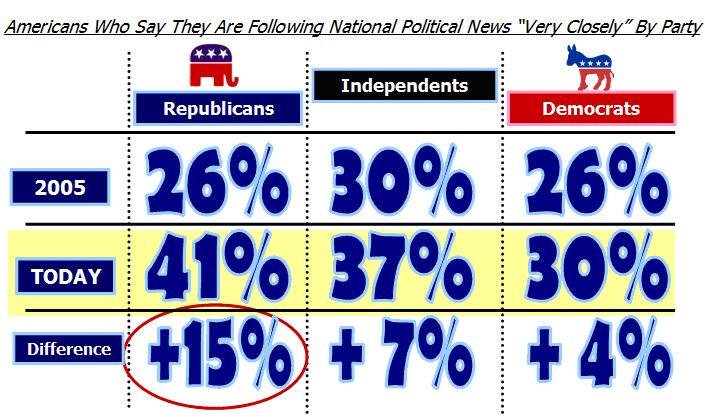
However, what’s driving this year’s unusually high number is the surge in Republican interest. In 2005, the last year following a presidential election, Republicans, Independents, and Democrats all reported roughly the same level of interest in the news. But this year, four-in-ten Republicans say they are following national political news “very closely” – up 15 points from 2005, and fully 11 points higher than their Democratic counterparts today.
alex-blog-post-oct-6

Independents are also responsible for part of this higher number, and you know from my posting last week they are starting to turn on the president because of too much government intervention and spending. The combination of this Republican intensity and Independents beginning to desert President Obama is starting to translate to the ballot measure for 2010.

In our latest NBC/WSJ poll** the gap on the generic Congressional ballot is as close as we have measured since 2004 – just three points separate voters on a preference for Republican (40{09f965da52dc6ab4c1643a77bd40d1f729d807040cd8db540234bb981a782222}) or Democratic (43{09f965da52dc6ab4c1643a77bd40d1f729d807040cd8db540234bb981a782222}) control of Congress, with Independents preferring Republican control for the first time this year. This unrest among the electorate is not lost on those who would seek political office. Every day we’re seeing more and more Republican candidates around the country deciding to throw their hat in the ring, signaling there will be some interesting and exciting races next year.

Republicans don’t have the wind at their back as the Democrats did last election cycle…yet. But if the Obama Administration continues with its big government, big spending agenda they could well be paying the price next November when Republicans and Independents show up to register their dissatisfaction.
*National survey of 1,026 adults, conducted August 31 – September2, 2009.
**National survey of 1,005 adults conducted September 17-20, 2009. Congressional ballot results among registered voters only.
(Public Opinion Strategies partners with Peter D. Hart Research Associates to conduct the NBC/WSJ polls. Neither Peter D. Hart Research Associates nor NBC/WSJ are responsible for these conclusions.)


October 6 – R.J. Berry claimed victory in the race for Albuquerque mayor, defeating three-term incumbent mayor Martin Chavez and former State Senate President and congressional candidate Richard Romero. . Berry won with a decisive margin over his two opponents, earning 44% of the vote in the three-way race to avoid a run-off. Public Opinion Strategies is proud to be a part of Berry’s successful campaign team.

Berry pollster Nicole McCleskey will be posting on the race on our website in the coming days.

Health care and the economy have been front and center for several months now.  However, bubbling up in the background is the coming debate over whether to increase troop levels in Afghanistan and our latest NBC/WSJ poll* reveals the coalitional challenge President Obama faces on this issue.

On the surface, the public is fairly pessimistic about our progress there to date with 45% saying the war in Afghanistan against the Taliban and Al Qaeda has been successful but 50% saying it has been unsuccessful. Looking forward, Americans express even less faith – just 28% say they feel more confident the war will come to a successful conclusion versus 59% who say they are less confident. 

And, when it comes to increasing troops, Americans seem conflicted, or perhaps in favor of maintaining the status quo.  A straight up-and-down question produces majority opposition (51%) to increasing troop level while 44% support it; but a majority (55%) also say we should NOT have an immediate and orderly withdrawal of troops, while 38% say we should.

As we’ve seen in our research on attitudes towards the war in Iraq, this issue results in significant gender and generational gaps.  Men support an increase in troops (53% support, 43% oppose), and women oppose it (35% support, 59% oppose).  Americans under age 50 oppose sending additional troops (35% support, 62% oppose) while those age 50 or over support it by 52% to 42%. 

But, what’s more interesting in this data is the reverse coalitions this issue creates.  Republicans tend to be more optimistic about current progress (62% successful, 36% unsuccessful) than Democrats (37% successful, 57% unsuccessful), and a majority of Republicans support an increase in troops (60% support, 34% oppose) while a majority of Democrats oppose it (30% support, 67% oppose).  Independents are evenly divided (49% support, 50% oppose).

As this debate develops, President Obama may find himself in a tight spot. Does he say no to his generals on the ground who recently requested 40,000 additional troops so that he can keep his Democratic Base happy; or does he stand by what he committed to in his presidential campaign when he talked about Afghanistan as a “necessary” war to which he would devote additional resources? 

 *National survey of 1,005 adults conducted September 17-19, 2009.(Public Opinion Strategies partners with Peter D. Hart Research Associates to conduct the NBC/WSJ polls. Neither Peter D. Hart Research Associates nor NBC/WSJ are responsible for these conclusions.)

Public Opinion Strategies