“I don’t have to tell you things are bad. Everybody knows things are bad. It’s a depression. Everybody’s out of work or scared of losing their job. The dollar buys a nickel’s worth. Banks are going bust. Shopkeepers keep a gun under the counter. Punks are running wild in the street. There’s nobody anywhere seems to know what to do, and there’s no end to it…”
Okay, so life isn’t quite as bad as when it was described by newscaster Howard Beale in the 1976 movie “Network,” but our latest NBC/WSJ poll* is out and it feels like Americans followed Beale’s advice to go to their windows, open them, stick their heads out and yell (or tell your pollster on the phone): “I’m as mad as hell, and I’m not gonna take this anymore!”
Americans register their disgust on a variety of measures:
For the first time since President Obama took office a majority (52{09f965da52dc6ab4c1643a77bd40d1f729d807040cd8db540234bb981a782222}) say the country is off on the wrong track.
Congress’ approval rating continues to languish – 65{09f965da52dc6ab4c1643a77bd40d1f729d807040cd8db540234bb981a782222} disapprove of the job they’re doing, including 71{09f965da52dc6ab4c1643a77bd40d1f729d807040cd8db540234bb981a782222} of Independents and almost half (47{09f965da52dc6ab4c1643a77bd40d1f729d807040cd8db540234bb981a782222}) of Democrats.
In December last year 52{09f965da52dc6ab4c1643a77bd40d1f729d807040cd8db540234bb981a782222} of the public thought this year would bring”Democrats and Republicans in Congress in a period of unity by working together and reaching consensus.” Today, 57{09f965da52dc6ab4c1643a77bd40d1f729d807040cd8db540234bb981a782222} blames both parties for the partisanship in Washington.
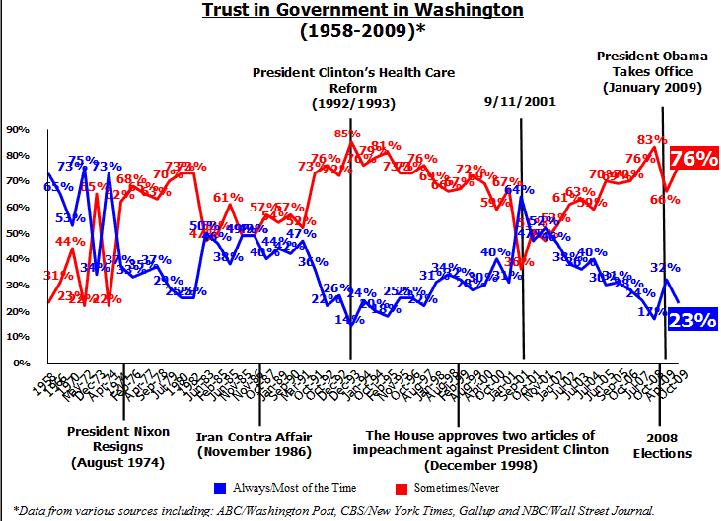
It gets worse…three-quarters (76{09f965da52dc6ab4c1643a77bd40d1f729d807040cd8db540234bb981a782222}) say they trust the government in Washington to do what is right “only some of the time” or “never.” To provide some context, this is worse than during/after Watergate, the Iran Contra Affair, or the Clinton Impeachment. The only time this measure has been worse is right before the 2008 elections and (hardly a coincidence) during the last go-around on health care reform when the Clintons were trying to jam government-run care through Congress.
There is no doubt this is bleak data, but it also provides a huge opportunity for the Republican Party to present its case to the American people and to be the out-Party that benefits. Certainly, if Republicans pick up some seats in next week’s elections – particularly in New Jersey and Virginia – it will be a turning point and a foundation from which the Party can build. It’s time for the GOP to offer a different way, to connect with the country, and to make a compact with voters for 2010.
*National survey of 1,009 adults conducted October 22-25, 2009
(Public Opinion Strategies partners with Peter D. Hart Research Associates to conduct the NBC/WSJ polls. Neither Peter D. Hart Research Associates nor NBC/WSJ are responsible for these conclusions.)
(This post was written by Glen Bolger and Jim Hobart.)
As the economy remains in turmoil, evidenced by a weakening dollar and unemployment continuing to move toward 10%, the question many Republicans ask is when blame for the poor economy will be shifted from the Bush administration to the Obama administration. However, this is the wrong question for Republicans to be focused on.
The majority of the nation continues to view Obama favorably (66% say they have positive feelings about him in the most recent NBC/WSJ poll) and thus wants him to succeed. They will be very hesitant to “blame” him for anything. As a result, the question Republicans need to be asking is not “why isn’t this his fault yet” but rather, “why aren’t the policies working like he promised they would?” This question is much more effective, because while voters are not ready to blame Obama for anything, they are ready to say his policies are not working.
In a recent Washington Post/ABC News poll, adults were asked if they thought Obama’s economic program was making the economy better, making it worse, or having no effect. While it would be easy for Democrats to point to the 41% better/22% worse figure as good news, the more important take away from the data is that a significant majority (57%) of adults do not think Obama’s economic program is making the economy better.
As a president elected specifically on a platform of change, people expect Obama to be able to do just that – change things. Nine months into his presidency, a majority of people do not believe his policies have been able to change the economic situation for the better. This is a significant problem for his administration and represents a real opportunity for Republicans. (It’s worth noting that the 57% figure is probably the best that Democrats can hope for, as the WaPo poll was of adults, rather than of likely voters. Adult samples are more Dem than likely voter surveys.)
Continuing to look at the recent Washington Post/ABC poll, respondents were told that many economists said the recession was over. Respondents were then asked if, given their own experience of economic conditions, they thought the recession was over. Fully 82% said they believed the recession was not over, while 16% say that it is. This number is a major problem for Democrats, and a clear call to continue to hold Democrats feet to the fire on the economy, as I advised in my post a few weeks back. Dem claims on the economy, from their vow that the stimulus would keep unemployment around 8% to their assertions late this summer that the recession was drawing to a close, have all proven to be false. Let’s not let voters forget it.
The semi-secret Democracy Corps poll that I’ve been blogging about all week (here, here, and here) is chock-full of heavenly data. It really is interesting — and my focus spurred our friends on the left to write a response.
The last analysis I’m going to write on it focuses on their economic message testing for the two parties. It’s a very interesting and well-done series. The good news for Republicans is that the intensity of support for the GOP messages on the economy is stronger than the intensity of support for the Dem messages.
As a reminder, the survey was done of 1,500 total voters — 500 in 20 Tier 1 Dem congressional seats, 500 in 20 Tier 2 Dem congressional seats, and 500 in 20 targeted GOP congressional seats. Often in these analysis I have been separating out the Dem and GOP seats, but for the message testing component of their survey, I’m going to focus on the overall data for the 1,500 interviews (so all 60 seats combined).
They tested a series of messages about what both the Dems and the GOPers “might say about the economy” and then asked how convincing respondents found each statement. The results of the six Dem messages point to some that have credibility with a majority of voters in these 60 districts, but those messages lack intensity. In comparison, they tested four GOP messages on the economy, and all four have higher intensity than any of the six Dem messages. Three of the four GOP messages have significantly more pop (a quick shout out of thanks to the folks at Democracy Corps for writing such well-crafted GOP messages for us to steal).
Here’s the wording of the Dem messages, with the results:
This past winter our nation was facing the worst economic crisis since the Great Depression, 700,000 jobs were being lost per month and our financial system was on the verge of collapse. We still have a long way to go and we will not rest until those Americans who seek jobs can find them, but thanks to the bold and decisive actions we have taken since January, we have pulled this economy back from the brink. Results: 43% convincing, 55% not convincing. Intensity: 16% very convincing.
We inherited an economy that has left far too many Americans struggling to make ends meet, so we are acting to help them get through this crisis by extending unemployment and health care benefits to Americans who lost their jobs, cutting taxes for 95 percent of working families, and preventing thousands of police officers, teachers and firefighters from being laid off. And as we move forward we are working to make sure that the economy starts to create new jobs again as it begins to pull out of this recession. Results: 56% convincing, 43% not convincing. Intensity: 26% very convincing.
When President Obama was sworn in, almost 750 thousand Americans were losing their job every month. The actions we’ve taken have cut that number by two-thirds, so we’ve made progress in stemming the loss of jobs. But we are not satisfied and a jobless recovery isn’t good enough for us or the American people; that is why we won’t stop fighting until our economy is once again creating high quality jobs. Results: 53% convincing, 45% not convincing. Intensity: 20% very convincing.
Last year our economy was on the verge of collapse so we had to make the tough choices and act, even though we knew it would be unpopular because it would help Wall Street. Now that we’ve averted the worst, we’re working to fix this broken system so it rewards the hard work of middle class Americans and small businesses that play by the rules instead of the big bankers that abused the system to get ahead. Results: 49% convincing, 49% not convincing. Intensity: 17% very convincing.Even before the financial crisis the economy wasn’t working for too many middle class Americans. That’s why we are working to rebalance the economy to make sure it works for regular Americans by asking the very wealthy and big corporations to pay their fair share while cutting taxes and reducing health care costs for working families and small businesses and creating quality, middle class jobs in alternative energy. Results: 54% convincing, 44% not convincing. Intensity: 26% very convincing.
The financial crisis showed that our economy was too reliant on unsustainable financial bubbles. We are working to change that and lay the groundwork for true long-term prosperity by reforming health care to bring down costs for business and consumers and making America the leader in alternative energy like wind and solar so the jobs and industries of the future are built right here, not in China or India. Results: 53% very convincing, 45% not very convincing. Intensity: 21% very convincing.
So, some of the Dem messages had majority resonance, but generally we look for intensity numbers of 30% or higher. None of those six messages reached 30%, although it is easy to see which messages worked better than others. Now, look at the intensity on the four GOP messages they tested:
The Democrats said all of their spending would create jobs, but their trillion-dollar stimulus plan, four-trillion-dollar budget and government bailouts have created more debt than at any other time in our history and yet unemployment is still rising and will soon top 10 percent. And they want to pay for all of this by making middle class Americans pay higher taxes on everything from energy to health care. Results: 53% convincing, 44% not convincing. Intensity: 35% very convincing.
The Democrats in Congress are more interested in bailing out Detroit, Wall Street and the housing industry with taxpayers’ dollars than they are in helping regular Americans during these difficult times. Democrats even let insurance giant AIG use taxpayer dollars to give millions in bonuses to its top executives. It’s time Democrats start helping out Americans on Main Street, not Wall Street. Results: 55% convincing, 42% not convincing. Intensity: 28% very convincing.
Democrats in Congress have approved 5 trillion dollars in spending this year alone, adding over a trillion dollars to our deficit that will leave mountains of debt for our grandchildren to pay back, money that America is borrowing from China and the Middle East. This irresponsible, wasteful spending undermines our economic stability by forcing us to rely on hostile foreign governments to lend us money. Results: 58% convincing, 40% not convincing. Intensity: 32% very convincing.
Our economy is in a severe recession but the Democrats only solution is greater government control. The federal government runs General Motors and has nationalized several banks. Democrats say they’re doing what it takes to get our economy back on track but what they’re really doing is pushing us on a path toward socialism, increasing the size of our federal government to levels only seen in European countries. Results: 52% convincing, 47% not convincing. Intensity: 33% very convincing.
The GOP message with the least pushback focuses on the spending/debt moves by the Dems in Congress,making us more beholden to China and the Middle East. The GOP message with the most intensity ties together the stimulus, the bailouts, the budgets, and the rising unemployment. I addressed part of this a couple of months or so ago in this post. And, Resurgent Republic does a nice job of exploring the political impact of the deficit in some August focus groups that I was involved with.
Continuing on a theme of mine, I would also note that one of the two strongest Dem messages includes alternative energy jobs. As this past post points out, oil and coal by themselves are not an energy plan. Republicans need to include alternative energy in our messaging on that issue. Green jobs are the future — and an agenda that includes more oil, more coal (in certain areas) and more alternative energy is a stronger message than the Dem alt energy only line.
The semi-secret Democracy Corps poll, about which I have already blogged here and here, is chock full of interesting data, and today I’m going to analyze the shift in their party issue handling numbers. Our friends over at Democracy Corps beg to differ with my analysis thus far, and so have written a response piece on their blog.
To quickly rehash, their survey was done of 1,500 voters — segmented into three groups of 500 (why do Dems have more money for this stuff than our side?!) — 20 Tier 1 Dem seats, 20 Tier 2 Dem seats, and 20 targeted GOP seats. In general, there isn’t much difference between the Tier 1 and the Tier 2 data (although there is on some questions), so I’m just lumping them together into the 40 Dem seats (1,000 interviews).
I beg to differ with their differs (if there is such a word), and will write a response response post on Friday. The Greenberg team’s analysis is worth reading, because it provides a window into the thinking of one of the most influential Dem polling firms in the country.
But, between now and Friday I want to finish posting my thoughts on their survey. Today we’ll go through the party issue handling section. The folks at Democracy Corps make the case that by using the movement from a similar survey in April that I’m unfairly, and now to quote their response:
using an artificial base point – citing our April survey – well within Obama’s honeymoon, inflating the sense of movement.
Of course, that is not the perspective they had in April when they released that survey. Back then, there were no caveats about inflated numbers for Dems because of the Obama honeymoon (which many Dems, not necessarily the Greenberg folks, believed would last until Obama went to heaven to sit at the right hand of God). Besides, it has been a long time (2004 to be exact) since GOPers had numbers like this to get excited about.
Let’s take Democracy Corps newly-found argument to have merit, however, and leave the April data out of this analysis on party issue handling. The data still points to problems for the Dems. Problems that they haven’t had in quite some time.
When they asked voters in the key 40 Dem districts which party they thought would do a better job on the issue, the GOP did well on issues which in recent years we had fumbled away, and the Democratics (isn’t that what they always want to be called?) could do no better than tied on issues that the Dems usually do well on.
Let’s look at the issues. On the historically GOP issues of taxes, the budget deficit, and government spending, the GOP has a nine to ten point lead in the target Dem districts. In the target GOP districts, the GOP has a four to 13 point advantage.
On the historically Dem issues of health care and Medicare, the Dem advantage in the Dem target districts is one and three points respectively — within the margin of error. In the GOP target districts, the GOP has a one point advantage on health care, and a more typical eleven point deficit on Medicare.
And, on the current big kahuna issue — the economy, GOPers have a four point lead in Dem districts and a one point lead in the GOP districts. The economy has recently been the province of the Dems.
Even though I said I wasn’t going to mention the April data (on page 10), the amount of movement since then is striking (see it for yourself).
After getting our clocks cleaned on issues for the last two election cycles, it’s very encouraging to once again control GOP issues and also be competitive on traditionally-Democratic issues. While national surveys of adults might not show quite the same level of a GOP rebound starting, the Democracy Corps survey is more meaningful to political analysts like myself because the poll is focused on the most important congressional districts going into the 2010 elections.
Republicans would have to agree — the findings in this survey is the change we need.
By Jay McCleskey, Partner, Lincoln Strategy Group
Nicole McCleskey, Partner, Public Opinion Strategies
The Albuquerque Journal labeled the RJ Berry win in the mayoral race “a move to the right.” That is a true statement. But it’s not just because a Republican mayor was elected for the first time in over 20 years. It’s where that movement came from within the electorate that’s important to note when examining this election in the context of the overall 2010 cycle.
Berry’s victory was made possible because Republicans over-performed their registration/traditional performance numbers and swing voters who have been solidly in the Democratic camp for the last two cycles swung back and responded to more conservative messages from a Republican candidate.
It Should Have Been A Coronation
Most mayors running for re-election would love to have the political environment that was handed to Marty Chavez in his historic bid for a fourth term in office. Sixty-two percent (62%) of likely voters in Albuquerque felt the city was heading in the right direction and six out of ten had a favorable impression of the mayor himself.
The big tip that something was amiss was the re-elect ballot test where we ask voters if they would vote to re-elect Chavez or if they think it is time for someone new.By a two-to-one margin, voters told us they wanted someone new.
The Genesis of the Message
Our initial assumption was that voters wanted someone new because they viewed Chavez as an unethical politician and/or they were rejecting his overall record. But rather than basing the campaign on assumptions, we decided to do a focus group with soft Republican voters who had previously supported Chavez to test messages and themes.
The theme of the campaign emerged through our rich discussion with these voters: “What can the Mayor accomplish in 16 years that he has not accomplished in 12?” Voters had simply tired of Chavez – they didn’t despise him, nor did they discount some of his accomplishments. The theme captured the sentiment without appearing to trash a man they actually liked.
Out of the focus group, we set our compass on Northeast.As one group participant said: “We’re headed North in Albuquerque.We don’t need to go South.We need to go a little Northeast.”Hence, our campaign spent no time criticizing the state of the city.That was going to be a message that would fall on deaf ears and waste precious resources.
Rather than making the election a referendum on the city, we set out to make this a referendum on the specific spending and crime issues that would be the hallmarks of a Chavez 4th term.
The tone of that message was important. It was clear that the wish to elect someone new was not based on some harsher sense that the mayor was corrupt or even unethical. Voters viewed the mayor as ambitious, certainly.Pushy at times.Even sneaky.But, they did not view him as a bad guy. This informed the tone for the entire campaign.That’s why the first TV spot opened with the lines, “12 years. Some good. Some bad. Just time to turn the page.” Despite criticism from pundits that the message was not a sharp enough contrast to move voters, our research said differently and we drove the “12 years is long enough” theme home.
Developing the Narrative
Every campaign is a story that unfolds.We could beat the drum that 12 years is long enough, but what we needed to do in order to make the theme stick was provide solid examples and develop a viable alternative.
Richard Berry is a leader who studies issues intensely and works hard to come up with practical solutions. It is important to note that our message development never changed Berry’s position on any issue. Rather, our challenge was to find the intersection where Berry’s issue positions crossed with the opinion of the electorate and frame it in a way that reinforced the overall theme of the campaign. To accomplish this, we tested a series of about a dozen Berry campaign positions in a July survey that presented a problem and introduced the Berry solution.Three issues rose to the top:
<Fight property crime.
<Focus spending on basic city services and not a $300 million trolley car.
<Change the city’s “Sanctuary City” policy for criminals.
Some political commentators might suggest that these issues allowed Berry to consolidate the Republican base and catapult him into the mayor’s office.That’s only partially true.The part missed in much of the analysis is that these issues all had strong appeal among Independent and soft Democrat voters.
One such message that had tremendous appeal was to put Chavez’s plan to build a trolley/light rail system in Albuquerque in the crosshairs. The trolley/light-rail message presented the not-so-exciting issue of government spending to voters in a way that immediately connected. Looking ahead, the power a spending message had with swing voters could spell trouble for Democrats in 2010.
The sanctuary city policy was another hotly debated issue. Berry had come out against this policy very early in the campaign. Not surprisingly, liberals tried to make the issue about race, claiming that Berry was engaged in some form of race-baiting. It was a false claim that voters soundly rejected.
What these liberals missed is that ending sanctuary city policy for criminals has just as much appeal to Hispanic voters as it does to white voters, and it worked well across party lines. Common-sense tells one that Hispanic voters in New Mexico, many of whom can trace their family roots in this state back centuries, will not view policies aimed at cracking down on violent gang members from El Salvador as somehow an attack on them and their family.
To our benefit, Chavez bought the liberal spin that this was a base Republican message, dug in his heels, and went right down the ill-advised road of defending a wildly unpopular policy. Berry, on the other hand, did not get rattled by the loud shrieking from the Left and stayed focused on appealing to swing voters by driving a common-sense policy change. Berry had the right message – ending the sanctuary city policy was not about race; it was about public safety.Voters of all ethnicities and parties understood and responded.
Getting There: How to Cross the Finish Line
We felt confident in the message.Next came the tactics of how to get to 40% of the vote in Albuquerque in a three-way contest.That objective is fairly daunting when you consider that Chavez was actually winning soft Republicans in our initial July survey (31% Chavez/30% Berry/23% Romero) and Berry was losing to BOTH of the other candidates among Independent voters (31% Chavez/24% Berry/27% Romero).
Winning over 80% of the Republican vote, as some have wrongly speculated Berry did to win this race, was never even a strategy. We certainly sought to consolidate the GOP vote, but we knew getting upwards of 80% would not be possible and we could not get across the finish line without winning Independent and swing voters. Using our vote models based on historic turnout in city elections, Berry had to win at least 70% of the Republican vote, more than 40% of the Independent vote, and 17% of the Democrat vote to pass the 40% threshold and avoid a run-off election. This would be no small feat.
We also knew that changing the make-up of the electorate by even a few thousand Republican votes would make the challenge less daunting.
One way to change the electorate was through absentee voting. In 2005, Chavez won 57% of the absentee vote.However, in 2009, Berry won the absentee vote, carrying 43% to Chavez’ 37% and Romero’s 20%.But that’s not the story. What made the absentee vote so crucial is the fact that 30% of the Republicans who voted absentee had not cast ballots in either of the last two city elections. This influx of new Republican voters helped create an overall electorate that was more Republican.
Turning to our vote models again, changing the profile of the electorate to a more Republican one pushed Berry close to 40%.But getting over the top required dominating the Independent vote and winning a significant chunk of soft Democrats.
And that’s exactly what happened.
The election night coverage was full of local Democrats and pundits expressing surprise that Berry was posting respectable numbers in Democrat strongholds. Even Richard Romero commented the next day that Berry “really surprised us with strength in some Democratic districts.”
The only reason this strength should have been a surprise was if one blindly accepted the premise that Berry’s messaging only had appeal to base Republican voters. That premise was proven false in our message development research and confirmed on Election Day.
Looking Ahead
In sum, we learned some important lessons in the Albuquerque mayor’s race that may have bearing in 2010:
1.Republicans want to vote this year (and next), which has big implications for turnout.
2.The Democrat lease on independent and swing voters that they have enjoyed for the past two cycles has expired. Conservative ideas trumped those of liberals among these key subgroups in the city election.
One election does not make a trend. It remains to be seen if Republicans will turnout in disproportionate numbers next fall and whether Republican candidates will win these swing voters in 2010 the way Berry did in this election. But it’s clear that the swing vote is once again up for grabs – and that’s change Republican candidates can believe in.
Jay McCleskey is a partner with Lincoln Strategy Group, which provided strategic general consulting to the Berry campaign, as well as producing the television, radio, and direct mail advertisements. McCleskey previously served as the Regional Political Director for the Republican National Committee from 2005 to 2009 and managed the RNC’s Victory operation on behalf of President Bush’s successful re-election campaign in New Mexico in 2004. He can be reached at jay@lincoln-strategy.com.
Nicole McCleskey is a partner with Public Opinion Strategies, which provided opinion research and strategic advice for the Berry campaign. Nicole is a recognized political expert on Western politics and public opinion.POS has a client list that includes 18 U.S. Senators, 7 Governors, and over 40 Members of Congress.According to the trade publication Campaigns and Elections, Public Opinion Strategies has the best won-lost record of any polling firm on either side of the aisle. She can be reached at nicole@pos.org.