It wasn’t too long ago that some pundits were writing the obituary of the Republican Party. They jumped the gun.
While not out of the woods, there are clear signs that the Republican Party is off life support.
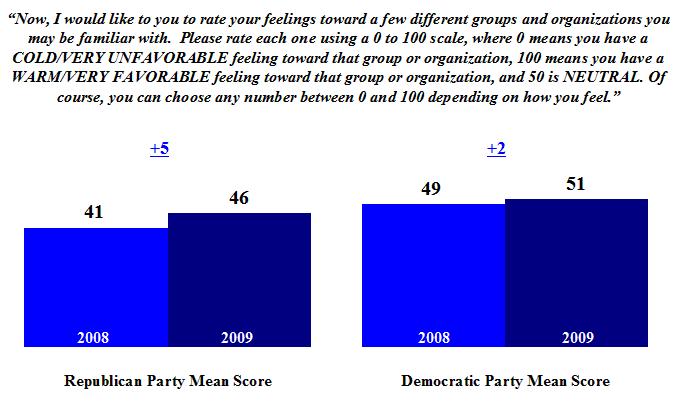
In a recent national survey conducted for the Republican State Leadership Committee, the Republican Party brand shows signs of new life. Compared to 18 months ago, general feelings about the Party have recovered a bit. Voters are not in love with the GOP yet, but perhaps in a reconciliation period.
The chart below shows the mean thermometer rating of the Republican and the Democratic Parties, comparing data from 2008 and 2009 (0=cold/unfavorable, 100=warm/favorable).
There’s also been movement among key political sub-groups, including Hispanics, white women, and Independents. In fact, among Independent voters, the image of the Republican Party (45) and the Democratic Party (46) is now essentially the same.
Even more importantly, voters are regaining their confidence in the ability of the GOP to solve problems. In February of 2008, the Democratic Party had a nine-point advantage on how voters felt they would handle the issue of “economic growth and job creation.” The Republican Party is back on even footing – actually asserting a one point advantage – after these first six months of the Obama Administration.
Republicans have also now re-asserted a dominant advantage over Democrats on the critical issues of “reducing state government spending” and “cutting taxes.” At the same time, voters are losing faith in the Democrats’ ability to “ensure affordable health care.”
These are all very positive indicators. We’ll have to go further to re-build in terms of presenting real alternatives and a better vision, but the road back feels better than the demise of the last several cycles.
If President Obama can give just one more speech, then maybe Americans will understand that government really does know best and can be the solution to our problems.
Not likely.
The American public has down an abrupt about-face in the last six months when confronted with the realities of an Obama Administration and Democratic Congress.
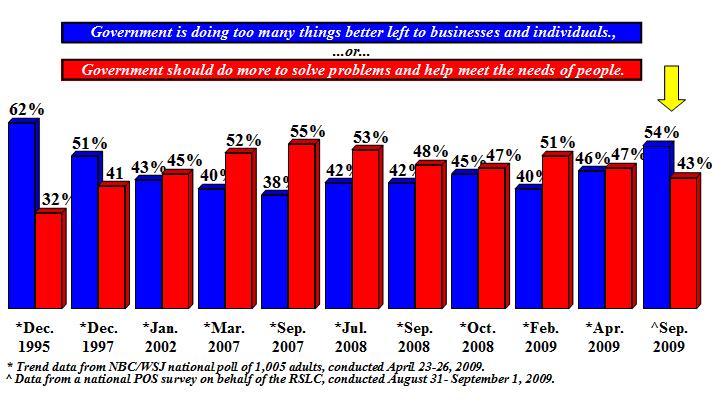
In a recent national survey conducted on behalf of the Republican State Leadership Committee, a majority of voters now think that “government is doing too much” for the first time in 12 years – 54% of voters say government is doing too much compared to 43% who believe government should do more to solve problems and help meet the needs of the people. This represents a 22-point shift in sentiment since Obama took office when 51% of voters felt government should be doing more.
Government over-reach is having a big impact on swing voter groups. By substantial margins, Independent voters, suburban women, Blue Dog Democrats and voters in states Obama won with less than 55% of the vote believe that government is going too far.
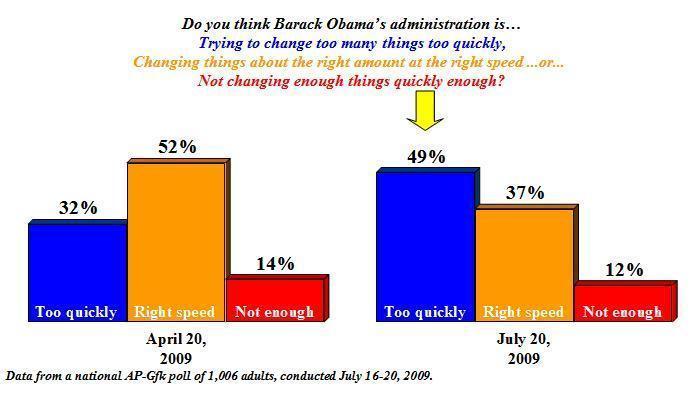
In another survey conducted by the Associated Press, in yet another dramatic shift, a near-majority of voters believe that Obama is moving too quickly in his pursuit of change. This marks a significant departure since April – just 4 months ago – when 52% thought the pace at which he was moving was about right.
Finally, in a July NBC/Wall Street Journal survey, voters express a loss of confidence in the course Obama has set for the nation. While a majority (54%) expressed confidence that Obama had the right set of goals and policies to be President back in February, a new majority (53%) now do not have confidence in his priorities.
The “change” Obama represents is more radical than American voters were prepared for. This backlash is a clear indicator that his efforts to “fix” the economy and reform health care are just more government than most voters can stomach.
By Neil Newhouse and Lisa Valentine
Barack Obama started his term as president with one of the higher initial presidential approval ratings in recent history (64% according to Pew). However, his approval score has fallen further and faster than any elected US President since the era of modern polling. (Just so you know, I am defining modern polling as starting with President Jimmy Carter in the 1976 election.)
Obama’s approval rating has dropped thirteen points during his first six months in office (from 64% in February to 51% in August). This ties him with Bill Clinton for the largest drop off in the first six months of any of the last six presidents. But, more than half of Clinton’s slippage occurred over the first two months of his presidency (remember “Zoe Baird” and “gays in the military”?), whereas the bulk of Obama’s slippage (10 points) has occurred over the last three months.
(Note to reader: Not only has President Obama’s approval score fallen from the post-inaugural heights, but current data shows that his “strong disapprovers” outnumber his “strong approvers” – underscoring the intensity of the sentiment moving against him.)
What’s caused Obama’s quick descent? In a nutshell, there’s been a lot of spinning of wheels and burning rubber, but no perceived progress. The mood of the country is no more positive, Americans don’t believe they’ve felt the impact of the economic stimulus package, and they have become increasingly skeptical of Obama’s “big government spending” response to the nation’s challenges.
The data is pretty clear, and the August recess/vacation has apparently done little to soften voter attitudes regarding the direction that President Obama is leading the country.
Presidential Approval
OBAMA
Date
Approve
Disapprove
DK/Ref
D/s
2/1/2009
64
17
19
47
3/15/2009
59
26
15
33
4/1/2009
61
26
13
35
4/15/2009
63
26
11
37
6/15/2009
61
30
9
31
7/15/2009
54
34
12
20
8/15/2009
51
37
11
14
*Dropped 13 points in approval in first 6 months
GEORGE W. BUSH
Date
Approve
Disapprove
DK/Ref
D/s
2/19/2001
53
21
26
33
4/22/2001
55
27
17
28
5/20/2001
53
32
15
21
6/17/2001
50
34
17
16
7/22/2001
51
32
17
20
8/1/2001
50
32
18
17
*Dropped 3 points in approval in first 6 months
CLINTON
Date
Approve
Disapprove
DK/Ref
D/s
2/23/1993
56
25
19
31
4/4/1993
49
29
22
20
5/2/1993
45
37
18
8
5/27/1993
39
43
18
-3
8/1/1993
39
46
15
-7
9/15/1993
43
43
14
0
*Dropped 13 points in approval in first 6 months
GEORGE H. W. BUSH
Date
Approve
Disapprove
DK/Ref
D/s
2/5/1989
55
12
33
43
3/13/1989
56
16
28
40
4/16/1989
58
16
26
42
5/7/1989
56
22
22
34
6/2/1989
63
18
19
45
7/9/1989
67
18
14
49
8/27/1989
64
18
18
46
*Improved by 9 points in approval in first 6 months
RONALD REAGAN
Date
Approve
Disapprove
DK/Ref
D/s
2/2/1981
51
14
36
37
3/16/1981
59
24
16
35
4/13/1981
67
19
14
48
5/11/1981
68
21
12
47
6/22/1981
59
29
13
30
7/20/1981
60
29
11
31
8/3/1981
59
28
12
31
8/17/1981
60
30
11
30
*Improved by 9 points in approval in first 6 months
CARTER
Date
Approve
Disapprove
DK/Ref
D/s
2/21/1977
71
9
20
62
3/7/1977
70
9
21
61
3/28/1977
72
10
18
62
4/18/1977
63
17
19
46
5/2/1977
63
18
18
45
6/6/1977
62
20
18
42
7/11/1977
62
22
16
40
8/8/1977
60
23
17
37
*Dropped 11 points in approval in first 6 months
* Data for Obama, George W. Bush, and Clinton is from Pew Research Center.
* Data for George H. W. Bush, Reagan, and Carter is from Gallup.
Mullings.com writer (and friend of Public Opinion Strategies) Rich Galen pointed out today that on the 100th day of his Administration, Barack Obama had a 67% approve/28% disapprove rating.
Now, however, after 224 days of his Administration, Obama has tumbled down to a 51% approve/42% disapprove rating. Thus, it took just 124 days for the President’s job rating to fall a net 30 points.
A lot of analysis has been done so far as to why. And the why of the drop has focused on substantive issues. The superfluous stimulus package, the flailing around on health care, and a foreign policy centered more on apologizing than on leadership.
The public has soured on Obama’s policy proposals. Voters often have only a fuzzy sense of what each individual proposal actually does, but more and more have a growing conviction that if the president is proposing it, it must involve big spending, big government and a fundamental departure from the traditional American approach.
Driven by this general anxiety, and by specific concerns, public opposition to health care reform is now steady and stable. Independents once solidly supported reform. Now they have swung against it. As the veteran pollster Bill McInturff has pointed out, public attitudes toward Obamacare exactly match public attitudes toward Clintoncare when that reform effort collapsed in 1994.
(I added the link to the McInturff release.)
But, it is also important to recognize the limits of Obama’s tumble (Brooks calls it a “slide” — I started this post with “tumble” prior to finding his column on Real Clear Politics). The biggest limit is that the President’s problems are NOT personal. At least not yet.
From a myriad of focus groups I’ve been doing over the last few months, it is clear that many swing voters still like President Obama and think that he is a good personal change from George W. Bush. Obama is perceived to be smart, a good communicator, and aggressively trying to solve problems. Where swing voters have doubts, however, is with his policies. They worry that he is biting off too much, too soon, and that he has a knee-jerk big government solution to every issue. Swing voters are concerned that approach will make our problems worse, not better.
Thus, this serves as a warning for us Republicans in the opposition. The Democrats are better at bitter personal attacks. As tempting as it is to launch the same style of attacks on Obama, the public is not ready for it.
I know that the Dems went hard after Bush 41 as being elitist and out of touch with the problems facing the country, and after Bush 43 for being intellectually incurious (i.e. stupid) even when both were popular. Those attacks became self-fulfilling prophecies as their approval ratings dropped because of policy problems (bad economy in 1991-92, Iraq War/Katrina mishandling in 2005-06). The combination of policy problems and personal attacks worked to steadily drive down both Bushs’ standings.
Thus, the temptation is there to launch personal attacks on Obama. However, we haven’t found any theme out there that has some resonance with swing voters (just because something works with the base doesn’t mean it translates to swing voters). People make jokes about the Chicago way of politics, but it has yet to stick to him — Obama is perceived so far as to transcend it (I’m not looking for a factual argument, just reporting public perceptions).
Obama is having significant problems based on his policies. Voters still like him personally. Plus, like it or not, the media’s infatuation with Obama’s truly historical role means they will be overly protective of him personally.
If part of your campaign strategy calls for including Obama in the messaging, it should focus on concerns with his policies, and not be personal. That may change down the road, but for now, avoid the temptation to lash back at Democrats with a personal attack on Obama. Instead, his downward momentum is based on policy, which after all, is the most important outcome of politics.
And, the Republican party still has image problems. By showing alternatives to Obama’s predilection for big government solutions, policy fights with the Democrats is the best way to improve the GOP’s image problem.