The incumbent party loses when voters say No Confidence
The Michigan Consumer Confidence Index numbers for August are out: 65.7, or one of the 33 worst months on record. The University of Michigan started the Index in winter of 1978 and has released data monthly ever since.
While not as predictive as one of our other favorite indexes, the Misery Index, the consumer confidence index is helpful in telling us what happens when the voters express a lack of confidence.
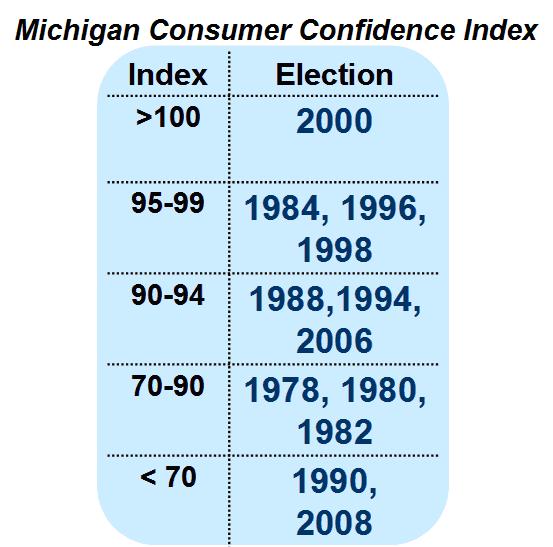
What happens when the Index is over 90 going into the November elections? The incumbent party generally wins re-election at the top of the ticket.
Well, almost. In October of 2000, the Index was 105.8 and George W. Bush (43) and Al Gore fought to what was politely described as a draw. Of course, it is now part of liberal folklore that the incumbent party, the Democrats, won.
Given the evidence of the Index, Gore SHOULD have won. Ronald Reagan won 49 out of 50 states on the back of a 96.3 Index and Bill Clinton won reelection with a near identical 96.5. George H. W. Bush (41) won a 3rd term for Ronald Reagan in ‘88 with a 94.1 and Bush (43) won reelection with a 91.7. Lesson to Al Gore and the Democrats: don’t lose your home state.
While index scores between 90 and a hundred can win reelection for the president’s party, the “90s” usually aren’t good enough for the incumbent party in midterms elections. The low 90s can even spell disaster.
Democrats lost their congressional majorities in ‘94 (92.7). In the 1998 “Impeachment Election” Democrats won seats in the House with a 97.4 Index followed by Republicans losing their majority outright in the Iraq/Katrina Election of ‘06 (93.6).
When the Index is in the ‘80s, no incumbent party survives – midterm or presidential cycles. The Democrats lost 15 seats in the House and three in the Senate in Carter’s ‘78 midterms (79.3) and Carter lost two years later with a 75 Index. The GOP lost 26 Seats in the House in the Reagan midterms of ‘82 (73.4) the GOP lost seats in the Bush (41) midterms of ‘90 (63.9) and Republicans lost at all levels in ‘08 (57.6).
As a reminder, the August numbers show 65.7.
By: Jeremy Ruch
This article highlights key findings from a merge analysis conducted by Public Opinion Strategies of all interviews conducted by the firm on national surveys since 2004. This merge analysis contains more than 100,000 interviews (and growing) and is a valuable tool for tracking demographic and attitudinal shifts over time. For more information about this merge analysis, please contact us at info@pos.org.
Republicans have lost significant ground in the Northeast* since 2004.
Nationwide, party ID has slipped from about even (-1) in 2004 to -7 in 2009. This trend is magnified in the Northeast. Republicans 10-point disadvantage in the Northeast (35% R – 45% D) in 2004 has eroded further to a 21-point deficit in 2009 (30% R – 51% D). The Republican defection happened at a similar pace in the Mid-Atlantic (-15 in 2004 to -26 in 2009) as it did in New England (-8 in 2004 to -21 in 2009).
Republicans in the Northeast now make up only 17% of GOP partisans nationwide, down from 20% in 2004. This decline in Republican identification has already altered the political map in the Northeast – not a single GOP House Member remains from New England, and several Republicans from the Mid-Atlantic lost in 2006 and 2008. Further, among the 24 state legislative bodies in the Northeast, only one – The Pennsylvania State Senate – is controlled by Republicans.
Northeast Republicans are slightly more conservative than they were in 2004.
Not surprisingly, voters who no longer consider themselves to be Republican tend to have far less conservative beliefs than those who remained in the party. Our April national survey demonstrated that among national voters who were formerly Republican, only 31% described themselves as conservative. Among steadfast Republicans, 70% called themselves conservative.
This merge analysis showed a similar theme among Northeast Republicans. In 2004, Northeast Republicans described themselves as conservative over liberal by a 58% – 7% margin (+51). In 2009, Northeast Republicans say they’re conservative rather than liberal by 60% – 2% (+58). This conservative shift, however, is less dramatic than Republicans nationally who went from 63% – 5% (+58) in 2004 to 70% – 2% (+68) in 2009.
But, they remain less conservative than Republicans nationwide.
The 2008 merge data shows that Northeast Republicans are less conservative than Republicans nationwide by 10 points (60% Northeast – 70% Nationally) and also less likely to be pro-life (59% vs. 67%). And, when asked to rate their level of support for a number of groups using a scale of 1-10, they are less likely to call themselves a supporter of conservative religious groups (5.5 mean score vs. 6.3), less supportive of the NRA (6.2 vs. 7.1) and more supportive of gay rights (3.6 vs. 2.8).
The GOP has lost significant ground among several key groups.
(For a larger sample size among key groups, I looked at 2004 vs. 2008).
In 2004, Party ID among Northeast White voters was dead even (40% R – 40% D). As of 2008, Republicans faced a 12-point deficit (34% – 46%). Republicans have also lost a considerable amount of ground among Women (-19 in 2004 to -33 in 2008) and especially working women (-20 in 2004 to -42 in 2008). The trouble continues among suburban voters (-4 in 2004 to -17 in 2008) and seniors age 65+ (-8 in 2004 to -20 in 2008).
There’s evidence to suggest that the GOP decline in the Northeast was driven at least in part by the perception of President Bush. In 2005, Bush’s numbers among Northeast voters as a whole (42% approval) lagged significantly behind the rest of the country (49% Midwest, 54% South, 46% West). Not surprisingly, Bush’s 2005 approval rating in New England (40%) was the lowest of all the 9-point regions.
In 2005, Northeast voters were also more likely to name the war in Iraq as the most important problem facing the country (22% versus 16% Midwest, 17% South, 20% West). Concern about Iraq was especially high among New England voters, as 27% named it the most important problem.
Given that Bush’s job approval fell precipitously after 2005; and considering that concern about the war continued to increase; it follows course that Republican identification would decline in the Northeast. This was especially true among key groups like women, seniors and suburban voters – groups who have traditionally made up the softer edge of the Republican coalition.
Implications for the Republican Party
Republicans have obviously lost significant ground in the Northeast over the past several years. The dwindling number of Republicans means that GOP candidates in the Northeast are going to have to attract support from a significant number of Independents.
Generally speaking, Northeast Independents are more aligned with Republicans on a number of key issues. Both Republicans (18% Right Direction – 75% Wrong Track) and Independents (23% – 64%) are still extremely pessimistic about the direction the country is headed compared to the extreme optimism of Northeast Democrats (62% – 32%)). Independents are also more tempered in their assessment of President Obama, with 54% approving of the job he’s doing compared to 35% of Republicans and 93% of Democrats. Northeast Independents are largely undecided on the generic Congressional ballot – 24% support the Republican candidate while 30% support the Democrat.
On the issues, Republicans are faced with some tricky calculus. When it comes to naming the most important problems facing the country, Independents are closer to Republicans in how they rank government spending, the economy and moral values, while Independents are more closely aligned with Democrats on education and taxes. On health care, Independents split the difference between Republicans and Democrats.
How the GOP can Grow the Party in the Northeast
The Republican Party still faces some serious image problems in the Northeast. The July NBC/WSJ showed the GOP with a 21% positive and 42% negative image in the Northeast, lower than the party’s 28%-42% national image).
And, while President Obama’s approval rating has slipped dramatically across the country – especially on his handling of key issues – he still rates considerably higher among Northeastern voters. The July NBC/WSJ poll showed that voters in the Northeast rated Obama six points higher than voters nation-wide on his job overall (59% to 53%), 13 points higher on his handling of the economy (62% to 49%) and six points higher on health care (47% to 41%). However, even in the Northeast, Obama’s numbers regarding these issues continue to fall.
Republicans have reason to be optimistic for their chances in the Northeast in the near future. Polling indicates that voters across the region are unhappy with their incumbent and ready to make a change from Democrats like Jon Corzine, Chris Dodd, Deval Patrick, and David Patterson.
It’s clear that many voters in the Northeast have left the party over the past several years because of their disapproval of President Bush and his handling of the War in Iraq. In the current environment, many Independents and Soft Democrats are becoming increasingly concerned about the government over-reaching on issues like health care and the economy. The best strategy for Republicans in the Northeast may be to represent a common-sense alternative to voters who are uncomfortable with the Obama agenda.
*Northeast is defined as follows: New England – Connecticut, Maine, Massachusetts, New Hampshire, Rhode Island, Vermont; Mid-Atlantic – Delaware, District of Columbia, Maryland, New Jersey, New York, Pennsylvania, West Virginia
This is not a polling analysis. Instead, I thought it important to share two key strategic message points on the blog.
The first is, there has been a move afoot among Democrats and some in the media to claim that the economy has turned around. And, of course, they point to select stats to make their case. They also give the stimulus package credit.
Republicans can not allow this message to go unchallenged. And there’s a simple, historical model for challenging it — the 1992 elections. After the Gulf War, and before the impact of the peace dividend was realized, the country dropped into a major recession during the last 18 months of President George H.W. Bush’s term. As we recall from the admonition that “it’s the economy, stupid,” Bill Clinton rode unhappiness with the economy into eight years in the White House.
Back then, as the Democrats are doing now, Republicans pointed to slivers of good economic news and said that the recession was over. The Democrats slammed back effectively, however, pointing to still high unemployment rate as proof change was needed and that the economy was still a wreck.
The adage is that a recession is when you lose your job, and a depression is when I lose my job. Republicans need to aggressively point to the unemployment rate as proof that the Democrats running Washington (or the state) are out of touch with reality.
(This is NOT to say Republicans are rooting for the recession to continue. It IS to point out that 9.7% unemployment is no time for the Democrats to be claiming that things have turned around.)
The Obama Administration is claiming that the stimulus package has already created or saved one million jobs. Remember, the Democrats promised that passing the stimulus would hold the unemployment rate to 8%. If voters couldn’t trust Democrat math then, they sure shouldn’t trust it now.
The second strategic message point has, spontaneously, received a lot of attention since the President’s health care speech last week. And, that is Republicans can not allow certain aspects of the Democrat health plans to go unchallenged.
Many in the media have already weighed in on this — and yet they also keep contradicting themselves. They claim Republicans are making up attacks on aspects of Obamacare to scare voters.
Democrats, including the President, are calling Republicans liars. There’s already been enough written about Joe Wilson’s outburst (and next to nothing written about Dems saying Republicans are lying), so let’s skip over the whole “liar, liar, pants on fire” attack between the two sides.
The media has come down foursquare on the side of the Dems. Republicans can not afford to be cowed on fighting back against these attacks. There have been numerous articles noting that there is nothing in the legislation that deals with the policy concerns of the GOP on illegal immigrants or taxpayer funding of abortion. In fact, the Democrats in the House voted down numerous clarifying amendments.
Instead, the Democrat message is — “trust us on this, since we’re running the government we’ll make sure taxpayer dollars aren’t spent on abortion, and we’ll ask illegal immigrants not to use taxpayer health care.” That’s not a credible message, so Republicans need to continue holding their feet to the fire on these issues.
It’s also important to note that many of the Democrat claims are simply not true. As Robert Samuelson pointed out today, you can’t restrain costs and the impact on the deficit if you try to do all three legs of a three-legged stool — keep quality, keep choice, and cover everyone.
From his column:
The problem is that you can’t entirely believe Obama. If he were candid — if we were candid — we’d all acknowledge that the goals of our ideal health-care system collide. Perhaps we can have any two, but not all three.
. . .
Studies of various health proposals conclude that their long-term costs exceed their long-term financing. In its second decade (2020-29), H.R. 3200 — the main House bill — would increase federal budget deficits by $1 trillion, estimates the consulting firm Lewin Group. Total health spending would reach 28 percent of GDP by 2029. How can Obama claim to control costs and never add to the deficit? Well, he’d adopt a provision requiring “more spending cuts if the savings we promised don’t materialize.” Sound convincing?
It isn’t. Congress often enacts automatic triggers to control spending. The triggers usually don’t work. When they might bite, Congress delays or modifies them.
The media is in the tank for Obama on what they call Republican untruths about certain aspects of the health care. That’s a fight worth having because it energizes the GOP base, and has the added benefit of being true (or, at least arguably true) despite the media refs turning a blind eye to it.
We can have a fight over illegal immigrant coverage and abortion funding with the Democrats. The media isn’t really keeping an open mind about that fight. However, at the very least the press can agree that there is no way this bill won’t cost a LOT more than Obama and the Democrats are admitting. They don’t have a way to pay for anything close to the entirety of their program.
But, the bigger fight on health care is simply the Dem promise to provide something for nothing, when all along that something is going to cost a whole lot of money. The reason voters are expressing concern about Dem leadership of the country is that they are growing government too much and spending recklessly. Hold their feet to the fire.
Pre-Labor Day and pre-Obama’s health care speech to Congress: Public Opinion Strategies brought to your attention the very close parallels between the health care debate in 1994 when the Clintons tried (and failed) to jam reform through Congress, and today as Obama tries to jam it through.
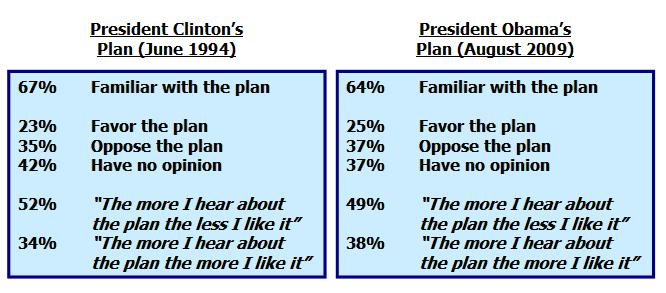
Indeed, our August data showed that public opinion of Obama’s health care plan was as bad or worse as the Clintons’ plan in 1994. In that poll we found more people were opposed to President Obama’s health care plan than at any point in 1993 or 1994. And, opposition was not just running along the usual partisan lines. Key swing voter groups, such as seniors, women, and Independents expressed the same level of opposition or more to Obama’s plan as they did to the Clintons’ plan fifteen years ago.
Our conclusion: President Obama was starting to learn the same lesson that the Clintons learned: Too much government intervention in the health care system can alienate more voters than it attracts.
Fast forward…
Post-Labor Day and post-Obama’s health care speech to Congress: Some polls are showing a modest bump in the public’s opinion for how Obama is handling health care reform. In the ABC/Washington Post poll released today, Obama’s job approval rating on health care is 48% approve; 48% disapprove compared to 46% approve, 50% disapprove in mid-August. (Although 32% “strongly approve” while 38% still “strongly disapprove.”)
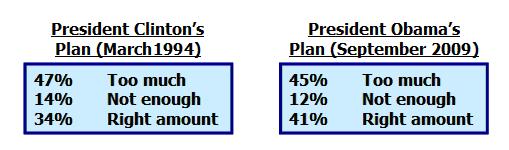
But, the ABC/Washington Post pollsters also included a very revealing question which helps illustrate our point about the public’s resistance to government involvement and continues to track the similarities between 1994 and today:
“Do you think the health care plan creates too much government involvement in the nation’s health care system, not enough government involvement, or about the right amount?”
Our conclusion: President Obama’s speech to Congress on his proposed health care plan may have served as a rallying cry for his liberal congressional allies, but his plan itself – as these numbers demonstrate – may be a bridge too far for voters who have had to endure one government intervention after another since he took office.
Today it is abundantly clear President Obama has a decision to make. He can choose to give the voters what they want by delivering a strong reform package that would improve the health care system without incorporating the government-run plan. Or, he can choose to give his liberal base what it wants by pressing forward with yet another massive government intervention that is unpopular with the public.
We’ve seen this movie before in 1994. Will President Obama choose a new ending, or will he opt to give us a dismal sequel?
Here’s a link to an important and interesting national survey released today by the Republican State Leadership Committee (RSLC), conducted by Nicole McCleskey.
Among the key findings:
— President Obama’s approval rating drop now ties Bill Clinton with the steepest decline in presidential approval ratings during the first six months in office.
— Important signs that the Republican Party is regaining some ground, including handling of economic growth and job creation.
— There has been a dramatic shift in the view of the appropriate role of government since Obama assumed office, with voters now assuming a “less is more” posture.
— Voters want the states to take a bigger role in policy-making and setting priorities.
— Nearly half the country thinks the Obama health care plan is a bad idea, and prefer the reform ideas coming out of states.