On March 3rd, when asked about the stock markets, President Obama responded by saying, “what I’m looking at is not the day-to-day gyrations in the stock market, but the long-term ability for the United States and the entire world economy to regain its footing. The stock market is sort of like a tracking poll in politics, it bobs up and down, day to day. And if you spend all of your time worrying about that, then you’re probably going to get the long-term strategy wrong,” he told reporters.
Well, pollsters use tracking to monitor reactions to new advertisements, new issues, and other events impacting the race to determine how voters are responding to the changes in the campaign. Tracking polls typically show either positive or negative movement or if they are like the nightly tracking poll during the 2004 South Dakota Senate race between John Thune and Tom Daschle, the ballot numbers will barely move over 40 days.
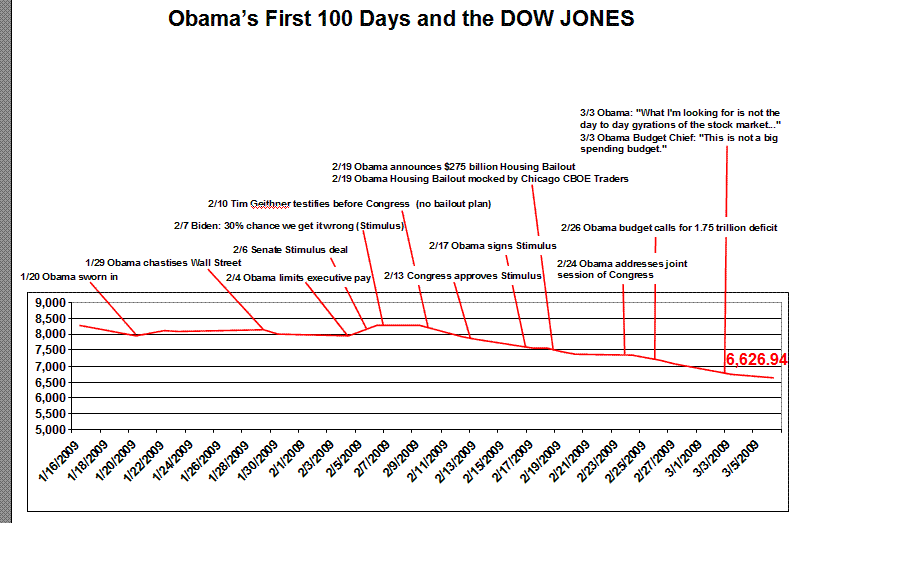
However, looking at the chart from Gene’s post yesterday, we see that since Barack Obama was elected the Dow Jones Industrial Average has dropped from 9139.27 on Wednesday, November 5, 2008 to 6626.94 on Friday, March 6, 2009, a drop of 2512.33 points (27%). Yes, in 2008 there was only one President, but I thought that was a good starting point to measure the reaction to the President-elect.
The Dow Jones Industrial Average is headed in the downward trajectory which is not good for the Administration, nor for the American public. In a political campaign, if the tracking numbers for our client were headed in this direction we would be talking with the campaign to encourage them to try a new strategy to help change the dynamics of the race and move the numbers in a more positive direction.
So while I can agree with President Obama to not focus on the day to day movement in the market, the downward directional data for last seven weeks is a trend that is alarming and unhealthy for the U.S. economy. The American public (62% of whom are investors) hope the President looks at the Dow Jones trend line and decides it is time to come up with a new strategy to instill confidence in the market to get the economy moving in a new direction. Here’s hoping the President’s daily economic briefing includes a chart similar to one below. Otherwise, his tracking polls might start looking like the Dow chart. While the Dow jumped 379 points today remember the President said he does not look at the day to day gyrations in the stock market.
You can keep up with TQIA on Twitter by following @POStqia. Glen Bolger is also on Twitter. You can follow him @POSGlen. We will keep you updated as other POS partners begin to use Twitter. We have also added a Twitter icon on the sidebar next to the RSS icon for your convenience.
Our friend over at Pollster.com, Mark Blumenthal, took an in-depth look at a question on the NBC/WSJ poll done by Peter Hart and Bill McInturff in a post entitled “When Does Gravity Begin for Obama.” From Mark’s post:
The point, again: Polls are best at providing snapshots of current attitudes, especially under hypothetical conditions. Results can mislead us when pollsters ask respondents to predict future attitudes and when we take their answers too literally.
I had a hunch that McInturff shared my skepticism, and he confirmed that intuition via email:
This is not a question we can ask the electorate confident they really know the answer. It would be interesting to track attitudinally, but not determinative. Voters do not “know” and will not accurately predict when, in aggregate, this economy becomes “his” in the public’s mind, but all previous research suggests at some time it will.
McInturff suggests that the so-called “right direction wrong track” question” provides a better way to watch Obama’s potential to sustain his current approval ratings. The latest NBC/WSJpoll showed showed a twenty-nine point increase since the election (from 12% to 41%) in the percentage of Americans saying the nation is “generally headed in the right direction” rather than “off on the wrong track” (a trend confirmed by others polls as illustrated by our right direction/wrong track chart). Most of that increase came from Democrats.
In Laura Meckler’s Wall Street Journalpoll story, McInturff explains the implications:
Typically, he said, presidential approval ratings hover about 20 percentage points above the national “right direction” number. With that figure at 41%, he said, Mr. Obama’s approval rating, at 60%, is sustainable and high enough to allow for major victories.
The key question, as McInturff frames it, is whether the “right direction” number will remain at or near 40%, or whether it will recede back to the 25% measured by most surveys in late January. A 25% right direction number would provide “a major barrier” to Obama sustaining his current approval rating. If that number remains at or near 40%, however, Obama could maintain a job approval rating in the high 50 percent range. So, he says, “let’s wait and see if [the right direction number] can be sustained at this high level given the very serious economic news.”
The article is well worth a read, as Mark checked in with Bill and they both shed some valuable light on predictive polling.
WKOW reported on the MacIver Institute poll conducted by Gene Ulm:
Wisconsin will elect a State Supreme Court justice and a new state school superintendent in the Spring election, and a newly released poll from the MacIver Institute for Public Policy finds nearly half the likely voters have not settled on a candidate in either contest.
“At this point, these races are largely name identification contests,” said pollster Gene Ulm. “Since none of the candidates has really launched their advertising campaigns yet, the races for Supreme Court and Superintendent are wide open – and they could go either way.”
Also mentioned was the Wisconsin Governor’s race in 2010:
In a contest featuring Doyle and Walker, 43% say they would likely back Walker, while 50% say they would probably support Doyle. 7% of the respondents were undecided between these two candidates.
The numbers are nearly identical in a match-up featuring Doyle and Neumann, with 42% saying they would probably vote for Neumann and 49% saying they would likely back Doyle. 9% of the respondents were undecided between these two candidates.
“The results show that Walker and Neumann are ‘statistical twins,'” said Ulm. “Either man would be a strong challenger to Governor Doyle should he seek re-election.”
Another topic mentioned is Governor Doyle’s approval ratings:
The survey shows Governor Doyle enjoys a 52% approval rating among likely voters, with 42% saying they disapprove of the job Doyle is doing as Governor.
“While Governor Doyle’s approval rating is the same as when he was re-elected in 2006, the overall numbers don’t tell the whole story,” said Ulm. “His support is soft with only 15% of the respondents saying they “strongly” approve of the Governor’s performance.”
The economy remains the number one concern for state residents, with 64% saying it is the single most important problem they face today according to a new poll released today by the MacIver Institute for Public Policy.
“The economy is the only issue right now,” said Gene Ulm a partner with Public Opinion Strategies, the firm that conducted the study for the MacIver Institute. “People are worried about their money, they’re worried about their job, and they’re not sure when things are going to get better.”
When asked “what is the single most important problem” facing them and their families, 64% of state residents said the economy – far more than any other issue. 15% of residents said their top concern was health care while 6% said taxes. Even fewer residents chose crime, education, state and local government or the environment as the most important problem. The portion of residents listing the economy as their top concern has risen 17 percentage points since a similar survey was conducted in May of 2008.
Most say state and nation are on the wrong track
“People are upset; they’re angry; they think things have gotten seriously off track” said Ulm. “The overall mood remains sour.” Indeed, 65% of those surveyed say things in this country “have gotten off on the wrong track.” An almost equal number – 64% – say things in Wisconsin are on the “wrong track.” Just 28% of state residents think the country is going in the right direction while 29% believe the state is headed in the right direction.
A new poll shows Democratic Gov. Jim Doyle has more support than his likely Republican challengers, but his approval rating hovers at the 50% mark.
The poll of 500 likely spring voters was conducted Feb. 25 and 26 by Public Opinion Strategies for MacIver. It has a margin of error of plus or minus 4.38 percentage points.
In matchups with likely Republican opponents, he bested Milwaukee County Executive Scott Walker (50% to 43%) and former U.S. Rep. Mark Neumann (49% to 42%).
The poll showed Doyle with a 52% approval rating and a 42% disapproval rating.
Doyle — who hasn’t said whether he will run for re-election — wouldn’t be on the ballot until November 2010.
The poll was commissioned by the new MacIver Institute for Public Policy, which has not yet released the results.
President Obama: “What I’m looking at is not the date-to-day gyrations of the stock market…” Well, he should be. The Dow Jones Industrial Average has dropped more than 2,500 points and lost 27{09f965da52dc6ab4c1643a77bd40d1f729d807040cd8db540234bb981a782222} of its value since November 5. Why is this important?
The market isn’t just for rich people anymore. And, it hasn’t been for some time. With the invention of IRA,s, SEP-IRAs, 401Ks and tax-deferred college savings plans, a recent Gallup survey showed 62{09f965da52dc6ab4c1643a77bd40d1f729d807040cd8db540234bb981a782222} of American adults own stocks and other equities – a figure that has jumped from 32{09f965da52dc6ab4c1643a77bd40d1f729d807040cd8db540234bb981a782222} in 1989 according to published studies.
To underscore how many Americans now are invested in the stock market, prior to the Crash of ‘29, the crash that shook the world has become part of the American ethos, only three percent of Americans were stockholders. Multiply that by 20 and then some to get to today’s numbers.
The point is that far from being the providence of America’s wealthiest, the stock market is now part-and-parcel of America’s main stream. And, well over half of America has suffered double-digit losses in their retirement plans since Barack Obama’s election. A fact Americans are reminded of every month when they receive their financial statements.
To be sure, American’s don’t blame the president now for their woes. But, they will if the losses continue. If the president continues to ignore it, it will become apparent that he has no strategy to put America back on track.
Worse than no strategy is a wrong strategy.
The market’s slide-causing sell-offs as a result of the President (or his proxies) near daily policy roll-outs and proclamations is a rational response to events. Started under President Bush, President Obama has continued Washington, DC’s displacement of New York and other world financial centers. Since last fall, government has been one of America’s few growth industries. As a percent of America’s Gross Domestic Product, federal government spending has grown from 21{09f965da52dc6ab4c1643a77bd40d1f729d807040cd8db540234bb981a782222} to 28{09f965da52dc6ab4c1643a77bd40d1f729d807040cd8db540234bb981a782222} since President Obama released his budget.
So when President Obama and Congress massively expand government expenditures while drawing down the pool of private investment, a market dive has been the inevitable result. Union pension fund managers and traders alike will always look to preserve and protect their shareholders (who now represent six-in-ten Americans) regardless of their politics.
America’s loss of wealth since election day has been enough to turn CNBC Mad Money man Jim Cramer, a professed Obama supporter, against the Obama Bear Market. If the President doesn’t watch the Dow, voters will follow in time.