Ron Brownstein, one of the sharpest political analysts in the media today, took an in-depth look at the recently released survey project on economic mobility conducted by Public Opinion Strategies and Greenberg Quinlan Rosner Research.
Ron focused on the Americans views on this country as a meritocracy, and how that may impacts Obama’s goal of significantly growing the size and role of government.
Included in Ron’s observations:
The poll (which surveyed 2,119 adults from January 27 through February 8) didn’t directly address the immediate political debate; but it charted, with unusual scope, the backdrop of underlying attitudes against which the argument between the parties is playing out. And it offered warning flares for both sides. Overall, the survey found that most Americans-across class lines-still believe that the most important factor in whether people get ahead is their own talent and effort, not broad social and economic conditions. By a decisive 71% to 21%, those polled said upward mobility depended more on the “individual person and things like hard work and drive” than “outside factors and things like the economy and their economic circumstances growing up.” At least three-fifths of those surveyed at every income level picked individual effort as the key to success.
He also noted:
That inclination to look toward individual initiative as the key factor in success tilted most of those polled toward Republican perspectives on two key questions. While many Democrats from Obama on down argue that the rewards of economic growth have been unfairly tilted toward the affluent for roughly the past quarter-century, ensuring “fairness” was less of a priority for most of those surveyed than expanding opportunity. Asked whether it was “more important…to reduce inequality in America or to ensure everyone has a fair chance of improving their economic standing” just 21% picked reducing inequality, while a resounding 71% put greater priority on ensuring opportunity. Those results were virtually unchanged at every rung along the income ladder, and suggest the limits of a Democratic message that sells redistributive tax policy primarily on the grounds of economic fairness.
He wasn’t all GOP-rosy in his analysis, as Brownstein pointed out some warning signs for the Republicans:
So what’s the bottom line? The pollsters conclude: “At its core, the nation believes that economic mobility is largely determined by individual effort and choices, and [it] values equality of opportunity over equality of outcomes.” That’s a cautionary signal for Obama and his Democratic Congressional allies. But the survey also makes clear that while Americans are skeptical that government is now helping to expand opportunity, they still believe a wide range of government interventions could help to do so. That’s a cautionary signal for Republicans effectively arguing that the most important thing government can do in the current crisis is to simply get out of the way. Above all, for both sides, as Walker says, “the main story is about what makes America different and what makes America unique, and strong and resilient.” Even in the midst of the most unnerving economic downturn since the Depression.
Jim Burton adds thoughts on the CDC report on cell-phone-only rates by state.
The Carrboro Citizen discusses last week’s Pew Economic Mobility Project survey.
Yesterday, the Centers for Disease Control and Prevention released a report detailing estimates of wireless-only households and adults by state.For researchers this information is a valuable resource because it is the only known estimate by state of wireless-only households.I was surprised to learn that one in four adults (25.1%) in Oklahoma are in a wireless-only household while in Vice President Biden’s home state just four percent of adults live in a cell-phone only household. To find out the percentage in your state check out the report.
The results come from the 2007 National Health Interview Survey and the 2008 Current Population Survey’s Annual and Social Economic Supplement.The report notes that “more than one out of every six American homes (17.5%) had only wireless telephones during the first half of 2008,” this is up from 14.7% in 2007. Be sure to read Mark Blumenthal’s description of the methodology of the surveys used to provide the estimates.
Wireless-only households are a conundrum for researchers who conduct telephone surveys, because many pollsters use random-digit-dialing sample.RDD sample includes listed and unlisted phone numbers while at the same time excluding many business numbers, but it does not include cell phones.
There are several problems researchers encounter when conducting surveys on cell phones; they are more expensive because researchers are not permitted to use predictive dialers to make the call, there is the problem of determining the respondent’s home location, and the respondent must be a safe environment to take the call/conduct the survey.
At the national and statewide level completing surveys with cell-phone only households is not too challenging because the geography is large, but becomes much more difficult when conducting surveys in smaller geographic regions including Congressional districts, counties, legislative districts and municipalities.
More and more pollsters are supplementing their landline surveys with cell phone interviewing as well.
In today’s Wall Street Journal, Gerald Seib writes:
But William McInturff, a Republican pollster who is co-director of The Wall Street Journal/NBC News poll, notes that an approval rating in the 60% range is about where new presidents often find themselves about now. Ronald Reagan and George H.W. Bush were in the same range at this point. Jimmy Carter actually had a 75% approval rating in Roper Center polling in mid-March of his first year. That certainly didn’t last.
[…]
Mr. McInturff and Peter Hart, a Democratic pollster who also oversees the Journal/NBC News poll, write in an analysis that it is noteworthy that confidence readings are lower “among groups that are likely to drift away from him eventually.” Among those in rural areas and small towns, for example, just 44% say they are confident in his goals and plans; 46% of independents say so. Confidence among senior citizens declined between January and March.
[…]
In response to poll questions, most Americans say they expect the recession to last for two years or so. Mr. McInturff thinks that, in reality, they will give the president less time, more like eight to 10 months, to show progress. Which reading is correct could be crucial.
“People still think that individuals matter a great deal in this country, more so than government in determining their fate and what happens to them,” says Glen Bolger, the POS pollster who worked on the survey and accompanying focus groups.
[…]
“There is a decided lack of trust in government to do things and do things well, but on the other hand people certainly see a role for government to enact certain policies [that can help] improve their economic mobility,” Bolger says.
A new study shows that Americans are optimistic that their economic prospects will improve within their lifetime and from one generation to the next. This, despite data that shows the United States has less economic mobility than many other industrialized countries.
A new study shows that Americans are optimistic that their economic prospects will improve within their lifetime and from one generation to the next. This, despite data that shows the United States has less economic mobility than many other industrialized countries.
* 79 percent said it is still possible to get ahead in the current economy;
* 72 percent said they believed they will personally be better off 10 years from now;
* 74 percent said they were at least somewhat in control of their economic situation, but only 43 percent said that other people were in control;
* 71 percent said personal ambition was a more important determinant of success than external conditions.
[…]
The survey, conducted between January 27 and February 8, also found widespread skepticism toward government efforts to reduce inequality. Some 46 percent said the government does more to hurt than help people’s efforts to move up the economic ladder.
You may not have heard the joke about the Congressman, the FBI agent and the ethicist, but if you attended HIGPA’s Pharmacy Forum (Feb. 9-11), you could have raised your hand and asked any one of them your questions about the issues facing the healthcare industry.
[…]
Additional highlights of the Pharmacy Forum included the following:
Bill McInturff, lead pollster for the McCain presidential campaign, recounted the events of 2008 from his unique insider’s perspective. He also discussed how healthcare issues played out in the campaign and how they are likely to figure in the days, months and years to come.
(This post was co-authored by Bill McInturff and Julia Sprague)
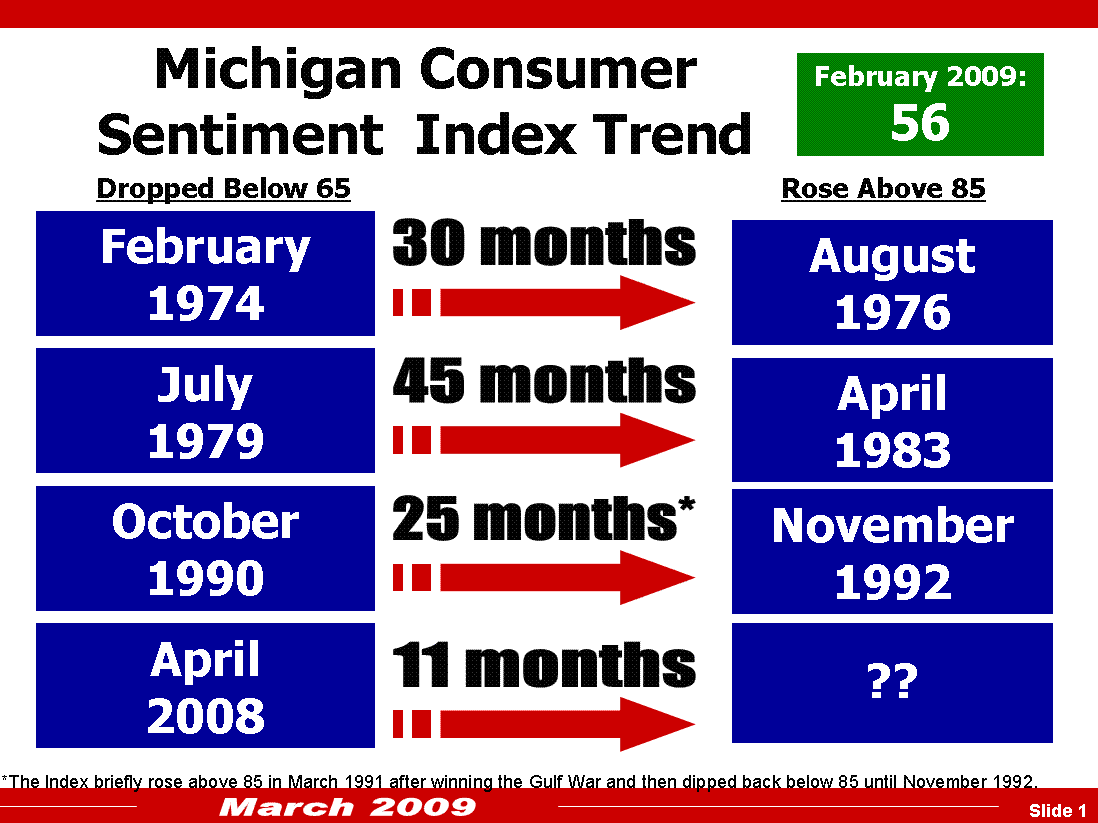
Public Opinion Strategies has been fascinated by the Michigan Consumer Sentiment Index (MCSI) for some time now. The MCSI is a monthly survey, with data available by month since 1978 and by quarter from 1952-1977, which gauges confidence among U.S. consumers.
Given the current recession and the big question of “how long will this last?” we examined past consumer sentiment downturns to see how long historically it takes before public confidence recovers.
Since 1952 when the MCSI began, there have been four periods where consumer sentiment dropped below 65: February 1974, July 1979, October 1990, and April 2008. We looked at the number of months it took after dipping below 65 before the Index climbed above 85 again.
In February 1974, it took 30 months for consumer sentiment to reach over 85. After July 1979, it took 45 months. After October 1990, it took 25 months total.* We are currently on month 11 since in dropped below 65 for the first time in April 2008.
The data is clear: it takes a LONG time. History suggests a consumer sentiment rebound is at least a two to four year process.