Republican analysts said the landscape is interesting, but not entirely surprising, considering how few conservatives aspire to serve decades in public office. “This is not something that conservatives do for life, generally,” said veteran GOP pollster Glen Bolger. “Over the years, a lot of conservatives have left to do other things. They’re not in public service quite as deeply as liberals; it’s part of [liberals’] genetic DNA.”
So, how does that affect public policy? “Well, is government getting smaller or bigger? It’s getting bigger. And there’s a correlation,” Bolger said. “It’s easier for liberals to not only win the battle, but over time, to win the war.”
More commentary and articles today on the NPR survey results.
A new NPR poll shows that Democrats are still in relatively strong position nationally — but Republicans have tied them in a question about generic preference for Congressional candidates, a potential trouble sign for a party riding a wave.
The poll was conducted by Public Opinion Strategies/Greenberg Quinlan Rosner Research from March 10-14. It consisted of a telephone survey of 800 likely voters nationwide. The survey carries a margin of error of +/-3.5 percentage points.
None of this is very surprising. We recently elected Obama by a margin in this range, and thereafter his popularity surged, as it would for any new president who presented himself well following his election. The public isn’t likely to repudiate that president’s policies less than two months after he takes office.
The most interesting result, I thought, is that self-identified conservatives outnumbered self-identified liberals by a margin of 45-19 (35 percent identified themselves as moderates). Obviously, there is a disconnect between this result and the answers to substantive questions about the stimulus plan, the budget, etc (though it should be noted that the pollsters stated the Democratic position in moderate sounding terms).
Right track/wrong track numbers have improved since last year (63 percent wrong track now versus 80 percent in May 2008) and are about where they were in March 2006, the last time the question was asked before Democrats won control of Congress in the November 2006 election (64 percent in March 2006).
Like several other national polls, the NPR survey shows the president’s approval at 59 percent.
Congressional approval has climbed back to 2007 levels (36 percent approve), an improvement over the lows of 2008 (22 percent).
Bipartisan polling is not new — a number of firms have teamed up on their own in similar ventures, and other media companies have hired such pairings.
But in this exercise, each of the firms wrote “their strongest messages in each area” and tested public reaction. On health care and energy matters, people sided with the Democratic message by a margin of 53 to 42 percent, the pollsters report.
“As Democrats hold the advantage on key issues, President Obama’s approval rating remains strong,,’ they report, with an approval rating for Obama similar to the one reported this week by the Pew Research Center. “Nearly six-in-ten voters (59 percent) approve of the job President Obama is doing while just 35 percent disapprove.”
A new poll conducted for National Public Radio shows that the “generic ballot” now shows no partisan advantage, with voters equally likely to say they’d support a candidate of either party.
President Obama remains popular with voters with a 58 percent approval rating. But it’s clear that the worsening economy and the congressional infighting over a stimulus package has taken a toll on the Democratic majority on Capitol Hill.
I know this is just one poll, but my question is whether it signals that there is an opening for Oregon Republicans in the congressional races next year.
In response to some of these attacks, camera vendor American Traffic Solutions (ATS) recently commissioned a poll of Missouri voters. In a press release issued today, pollster Neil Newhouse says 66 percent of Missourians favor the cameras as opposed to just 30 percent who oppose the devices.
Even more surprising — according to Newhouse — is the misconception that most Missourians disapprove of the cameras.
He says his study found that by a margin of 47 percent to 31 percent, most voters incorrectly assume that their neighbors oppose the cameras.
It has to grate President Obama and his team to read the recent Pew poll summary that notes that Obama’s current job approval ratings (59%-26%) “remain on par with George W. Bush’s ratings in March 2001 (55% approved, 25% disapproved).”
In fact, after nearly eight weeks in office, Obama’s job approval has slipped under the 60% mark in a number of public polls, and his disapproval has reached the mid-30’s (Pew, Rasmussen, NPR).
Interestingly, the Pew analysis points to an ideological factor as a potential explanation for the shift in his approval scores. Their polling shows that by a 44%-30% margin, voters believe that Obama is listening more to liberals in his own party over moderates. And, that represents a significant change from January, when voters believed he was listening more to moderates of his party by a 44%-34% margin.
So, perhaps that perceived ideological shift can partially explain the slippage in the President’s job approval among Independents – from 63%-14% to 57%-27% and among GOP’ers – from 34%-41% to 27%-56%.
Looking ahead:
Expect President Obama’s job approval scores to fall further – probably to a level 17-20 points above “right direction.”
As Obama continues his trash-talking about the AIG bonus issue, he may be unwittingly taking ownership of the issue as well, potentially highlighting his inability to impact AIG’s behavior.
It’s only a matter of time before Obama takes ownership of the economy, and that time will certainly come before the next election.
As Obama’s numbers continue to slip, Congressional Democratic leaders will feel emboldened to push their liberal agendas, potentially pulling the President further to the left.
Eight weeks into Obama’s Presidency, is he already on the bubble?
NPR covers their poll conducted by Public Opinion Strategies and Greenberg Quinlan Rosner:
The economy is weighing heavily on Americans’ minds, according to a new NPR poll that shows it dominating all other major issues. An overwhelming 97 percent of respondents say the economy is doing poorly, but there are doubts that the stimulus package will be enough to help.
The economy and jobs were listed as the top issue by 56 percent of respondents, followed by 11 percent who said taxes and spending were most important. By comparison, only 3 percent cited the Iraq war, and 1 percent named the war in Afghanistan as the top issue.
The first measure of President Obama’s rating in the NPR poll, conducted March 10-14, shows 59 percent of Americans approving of the job he’s doing, compared with 35 percent disapproving. The reviews for Congress are nearly the mirror opposite of those for the president: 58 percent disapprove of the job it’s doing, while 36 percent approve.
In the face of a recession that has destroyed billions in family savings and home values, Americans remain convinced that personal initiative and hard work are the key to big rewards, and they continue to repudiate the idea of government intervention to alleviate economic inequality, according to two Pew-sponsored reports.
Not only do voters continue to be convinced, by large majorities, that they, and not government or big corporations, control their own destinies in the midst of the current recession, but they do so despite more long-term evidence suggesting that there is less class mobility in the United States than in most Northern European countries, or in Canada, and that U.S. wages have not kept up with productivity gains for the past three decades.
This conviction underpins the long-standing American hostility to a full-fledged welfare state — along the lines of many European counties — and underpins the lack of a strong socialist tradition in the US. It also shapes the debate over policies to deal with the current recession, including the Obama administration’s rejection of bank nationalization.
Glenn Bolger is quoted in a Salon.com piece about executive bonuses:
“[Voters] wouldn’t mind seeing some of the executives hanging from lampposts on Wall Street,” said Glen Bolger, a Republican pollster.
There are also a few stories on a poll conducted in Pennsylvania by POS along with Fairbank, Maslin, Maullin & Associates.
A coalition of environmental groups said Monday they’re launching a campaign in support of a severance tax on natural gas drilling from Pennsylvania’s Marcellus Shale strata.
The various groups, which range from the Pennsylvania Fish and Boat Commission to the American Farmland Trust, said during a telephone news conference that they want a portion of any severance tax dedicated to conservation purposes in the state.
The group also released a survey that showed that a majority of Pennsylvanians would support a tax on natural gas drilling.
[…]
David Metz, senior vice president with Fairbank, Maslin, Maullin & Associates, said the bipartisan poll of 600 voters was conducted from Feb. 28 to March 3 with Public Opinion Strategies.
According to Metz, 53 percent of respondents said they would support a severance tax, while 37 percent said they were opposed.
The NPR bi-partisan polling team of Glen Bolger from Public Opinion Strategies and Stan Greenberg from Greenberg Quinlan, Rosner Research just released a new survey this morning.
A new NPR poll shows that President Obama’s job approval rating is still high — 59 percent — and among likely voters surveyed, the Democratic position on issues was favored across the board. Still, there’s some reason for Republicans to hope. . .
. . .Then there’s the president’s job approval rating: a healthy 59 percent overall, and 56 percent on handling the economy. It is down from the mid-60s, but it’s just about where the past 4 presidents have been at this point in their terms.
Still, inside the Obama approval rating, there are data that are heartening to Republicans who have been waiting a long time for some good news — and Bolger is one of them.
“What I find encouraging is that in this survey, he’s under 50 percent approval among independent voters,” Bolger said. “I thought that, you know, given his rock star status, that he was going to be stronger longer with independents. But independents are becoming a little more skeptical. They haven’t turned on him by any stretch, but he’s not up on the pedestal among independents like he had been right after the election and right around the inauguration.”
Link to the questionnaire with the results here. We’ve also got charts of the results.
I will be posting more in-depth findings from the survey throughout the week, so be sure to check back.
Everyone knows President Bush left office with record disapproval rating of 67{09f965da52dc6ab4c1643a77bd40d1f729d807040cd8db540234bb981a782222} (from January 2009 NBC/WSJ survey). And it’s been part and parcel of the Democratic strategy to continue running against the former president. The Democrats who run campaigns aren’t idiots; they did it because it worked.
So, how long will the Bush Hangover last?
Combining the inflation rate plus the unemployment rate form a handy stat known as the “Misery Index.” Handy for pols because it is directly connected to Americans’ desire for change.
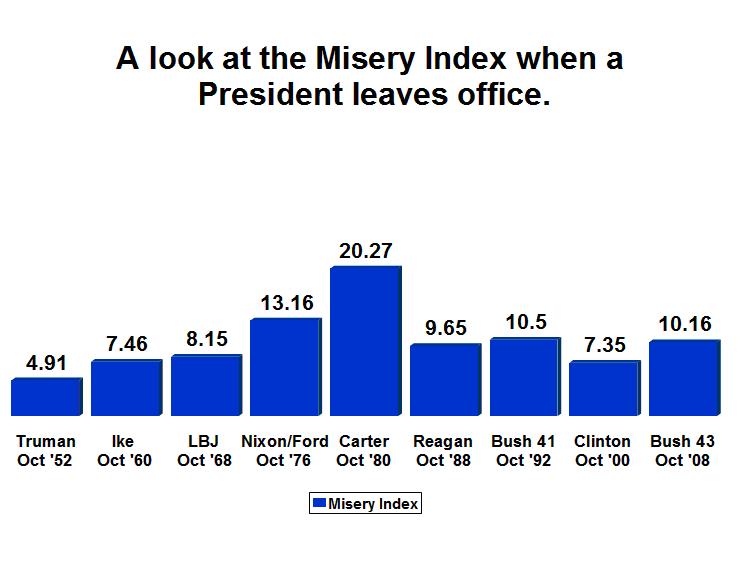
The Index was created by LBJ economist Arthur Okun and went public in 1976, when it became a staple in Jimmy Carter’s campaign against Gerald Ford. (See attached chart: Carter was killed with his own sword four years later). When we connect the dots between the Misery Index and election results, it tells us that Americans have little in the way of short-term memories and vote largely in the present.
How does the W’s 10.16 Misery Index measured October just prior to 2008’s Obama landslide stack up?
And there lies the first of several morals to this story: Bush’s Index was poor, but clearly not the worst. Second, it is VERY difficult for a party to maintain its hold on power when the Misery Index gets into the “8s” and extremely difficult when it gets into double-digits.
Presidents can defy gravity, but their party can’t. In November of ‘56, Ike coasted to reelection on the back of a 6.13 Index. But, by the fall of ‘58, the Index had risen to 9.22 and the Democrats won 48 more House seats and 13 more in the Senate. Nixon trounced McGovern in ‘72 (9.02 in October) but lost 48 House and five Senate seats in ‘74 (18.06). Reagan won 49 out of 50 states against Mondale in ‘84 (11.66) but for the mid-terms, the Index was 8.75 and the GOP lost eight Senate seats.
Which brings us to the moral of the story. Americans have a short term memory when it comes to change and are likely to change again if things don’t improve.
When President Reagan beat President Carter in ‘80; the Index was a whopping 20.27. But in 1982, blaming Carter didn’t work, the Index stayed high and Republicans lost 26 seats in the House as the Democrats rode a 15.54 Index into the November elections. In ‘92, President Clinton beat President Bush (‘41) with the “It’s the Economy, Stupid” campaign, aided by an Index of 10.5 going into November. What happened next? The Index stayed generally high (8.41 in October ‘94) and Republicans took the House and Senate.
So, where is President Obama today? The Index was 7.63 at the start of the year and 12.4 as of the beginning of the month, or a huge 625 basis point increase and rising. If President Obama and the Democrats maintain a double-digit Misery Index into the 2010 elections, “Crying Bush” will be of little help. However, if it drops into the mid-single digits, expect little in the way of change. Hint: with unemployment, half of the Index math, hitting high single digits by itself, this low of an Index could be a tall order for Democrats to achieve by 2010.
 And there lies the first of several morals to this story: Bush’s Index was poor, but clearly not the worst. Second, it is VERY difficult for a party to maintain its hold on power when the Misery Index gets into the “8s” and extremely difficult when it gets into double-digits.