In National Journal Magazine, Charlie Cook writes about the shift in public opinion of Republican candidates in the The Cook Report
Republican pollster Glen Bolger, who worked on the survey for Public Opinion Strategies, says that this is the first time since 2004 that he has seen independents favoring Republicans on the generic ballot test. Although he concedes that poll participants agreed — by margins of 6 to 11 points — with Democrats more than Republicans on each of the issues tested, he contends that the generic question’s results are “evidence that voters, particularly independents, are worried that they overcorrected in the 2006/2008 elections combined, and now have more of a liberal slant to government than they want. They want change but with checks and balances.”
Four major newspaper publishers have filed for bankruptcy since December of last year. The Rocky Mountain News in Denver has now entirely ceased to exist. With the Seattle Post-Intelligencer having produced its final print edition after 150 years of publishing and now going entirely on-line and its publisher, Hearst Corporation, considering doing the same soon with its San Francisco Chronicle, the print media appears to be facing an deadly epidemic. Are people just reading the on-line edition of the paper instead of bothering with a hard copy?
Recent research suggests that a high tech shift to the internet is only part of the issue. Overall newspaper readership in the country has declined despite a fairly dramatic corresponding growth in the on-line newspaper industry. Fourteen percent (14%) of Americans said they read an on-line newspaper yesterday according to the Pew Research Center’s 2008 news media consumption survey. This number is up from the nine percent (9%) who said they had done so two years earlier. Despite this fact, the survey findings still showed that only thirty-nine percent (39%) of Americans said they read any newspaper yesterday (whether print or on-line), down from a forty-three percent (43%) figure two years ago.
Americans are simply not following the news as closely as they used to, and this trend is not only the product of a new generation gradually replacing an older generation. The Pew Research shows that there has been a dropoff in newspaper readership even among the Silent and Greatest Generation voters (those born before 1946) and among the Baby Boomers (those born 1946 and 1964). Silent and Greatest Generation voters have dropped from sixty-five percent (65%) to fifty-three percent (53%) regular newspaper readers over the last decade, and baby boomers dropped from forty-seven percent (47%) to forty-two percent (42%) in just the last two years.
In our world, where much energy is poured into winning public affairs or political campaigns, this drop off in the print media is just part of a much bigger picture, a picture that shows all off-line media on the decline. Another Pew Research Poll, conducted November 6th through 9th of last year, asked 1500 actual election day voters where they got most of their news about the presidential election campaign. This same question, asked after the 1992 Presidential Election, elicited a response from eighty-two percent (82%) of Americans that they received most of their news from television. Not a single respondent cited the internet on that survey. In November of 2008, television was still the dominant news source for political coverage, but only sixty-eight percent (68%) of Americans now offered this response. On the other hand, the internet was cited by an amazing thirty-six percent (36%) of Americans. For the first time, more Americans cited the internet than cited newspapers (33%).
If print media is on life support and broadcast media is also clearly in decline, successful candidates and consultants must come to grips with everything the internet has to offer or risk their own loss of relevance.
Barack Obama is catching a cold on his economic policies. Sure, his numbers are a lot healthier than George W. Bush’s were in the last years of his Presidency, but there is danger in the data for Democrats.
This analysis results are based on a bipartisan survey conducted by Public Opinion Strategies together with Greenberg, Quinlan, Rosner Research for National Public Radio, which are not responsible for these conclusions.
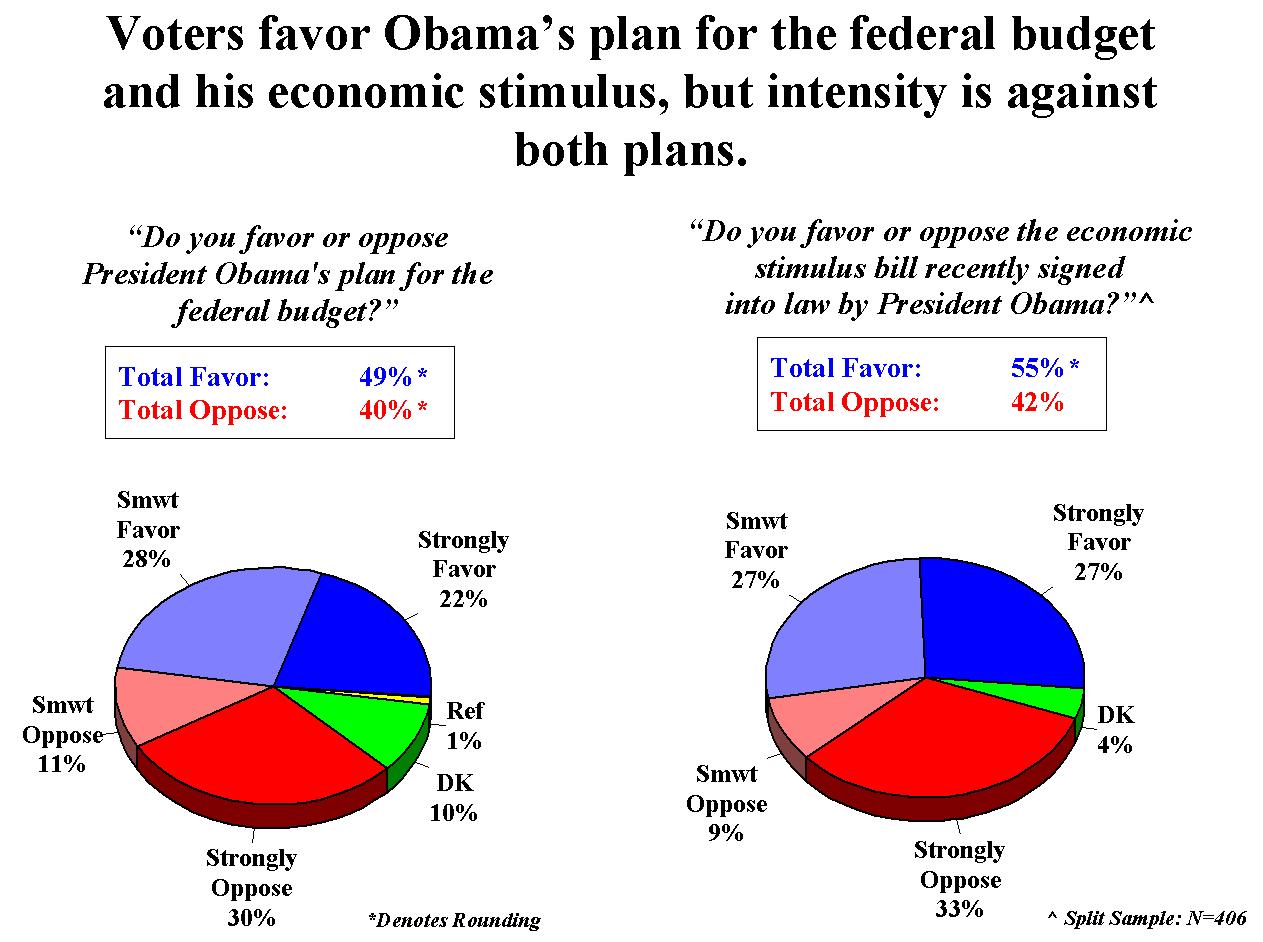
Only 49{09f965da52dc6ab4c1643a77bd40d1f729d807040cd8db540234bb981a782222} of voters favor President Obama’s plan for the federal budget, while 40{09f965da52dc6ab4c1643a77bd40d1f729d807040cd8db540234bb981a782222} oppose it. Not only is the President under 50{09f965da52dc6ab4c1643a77bd40d1f729d807040cd8db540234bb981a782222} on an issue that will be a key component of his Administration going forward, but intensity is against the budget. Only 22{09f965da52dc6ab4c1643a77bd40d1f729d807040cd8db540234bb981a782222} strongly favor it, while 30{09f965da52dc6ab4c1643a77bd40d1f729d807040cd8db540234bb981a782222} strongly oppose it. Thus, opponents of Obama’s budget are more fired up, ready to go than supporters are.
The budget is a net negative with Republicans, Independents, men, seniors, very conservative voters, somewhat conservative voters, frequent church-goers, and even the states that Obama won by less than five percent. His post-partisan model already is not working. Even more problematic for Obama is that he is on slippery ground in the political center. However Republicans shouldn’t underestimate the amount of personal good will that he has with voters, or the devotion his base of white Democrats and African Americans (regardless of party ID) have for their President.
Obama’s stimulus bill has a higher support level than the budget, but again runs into intensity issues. The overall number looks decent – 55{09f965da52dc6ab4c1643a77bd40d1f729d807040cd8db540234bb981a782222} overall favor it, compared to 42{09f965da52dc6ab4c1643a77bd40d1f729d807040cd8db540234bb981a782222} opposition (which is down from 63{09f965da52dc6ab4c1643a77bd40d1f729d807040cd8db540234bb981a782222} favor/24{09f965da52dc6ab4c1643a77bd40d1f729d807040cd8db540234bb981a782222} oppose in a CBS News/NY Times poll in January). However, the intensity is underwhelming – 27{09f965da52dc6ab4c1643a77bd40d1f729d807040cd8db540234bb981a782222} strongly favor/33{09f965da52dc6ab4c1643a77bd40d1f729d807040cd8db540234bb981a782222} strongly oppose.
While the Obama team made the campaign look easy, they are finding that governing is hard. And the specifics of the budget and the economic stimulus has weakened his standing. It’s stunning that less than two months into his Presidency there is more intense opposition to his key policies than support. Obama is moving past the sniffles stage and is in danger of getting a lot sicker a lot faster than anyone could have predicted in the “Months of Good Feelings” after his election.
Ben Goddard of The Hill writes about the recent NPR poll
Polls show that voters don’t agree with the senators. Rather than overreaching, they see the president as multitasking, and they think it is high time someone in Washington started doing that. A poll for the Pew Research Center found a solid 56 percent majority rejecting the suggestion that Obama is trying to do too much. Another survey conducted for National Public Radio by the bipartisan team of Public Opinion Strategies and Greenburg Quinlan Rosner found strong support for the president’s economic recovery plans. Fifty-six percent approved of the way Obama was handling the mess we are in. And they share his priorities for fixing things. Overwhelmingly, they say the president and Congress should be paying the most attention to the economy and jobs. Healthcare ties for second place with taxes and spending. Education is third most important, easing out the war in Iraq and terrorism on the list of critical issues.
PAUL adds: As I noted last night, a poll taken for NPR by Public Opinion Strategies and Greenberg Quinlan Rosner on March 10-12, 14 found basically the same thing. It had the two parties even on generic congressional preference.
The new national survey done for NPR by Public Opinion Strategies and Greenberg Quinlan Rosner Research is chock full of interesting data, including some good news for the GOP, as well as continued caution. I will be writing a new post per day this week on the NPR survey.
The best news is the generic ballot. The continued caution revolves around the Dems advantage on issues.
The generic ballot in this survey is tied at 42{09f965da52dc6ab4c1643a77bd40d1f729d807040cd8db540234bb981a782222} GOP/42{09f965da52dc6ab4c1643a77bd40d1f729d807040cd8db540234bb981a782222} Dem. This tie is despite Dem advantages on the issue contrasts, as well as a six point party ID advantage. The reason for the tie is simple – Independents are moving toward the GOP.
By party, the generic breaks down well for us – leading 85{09f965da52dc6ab4c1643a77bd40d1f729d807040cd8db540234bb981a782222}-3{09f965da52dc6ab4c1643a77bd40d1f729d807040cd8db540234bb981a782222} among GOPers, and trailing 7{09f965da52dc6ab4c1643a77bd40d1f729d807040cd8db540234bb981a782222}-83{09f965da52dc6ab4c1643a77bd40d1f729d807040cd8db540234bb981a782222} among Dems. Given that there are more Dems in the country, the reason the generic is tied is because the GOPer leads 38{09f965da52dc6ab4c1643a77bd40d1f729d807040cd8db540234bb981a782222}-24{09f965da52dc6ab4c1643a77bd40d1f729d807040cd8db540234bb981a782222} among Independents. That is not an advantage that will be easily held, but it is the first time since 2004 in which I’ve seen a national survey showing us up among Independents on the generic ballot.
My analysis? This is evidence that voters – particularly Independents – are worried that they over-corrected in the 2006/2008 elections combined, and now have more of a liberal slant to government than they want. They want change, but with checks and balances.
On the issues section of the interview schedule, the Dem wins all of the issue contrasts by six-eleven points. However, the GOPer wins among Independents by a handful of points on each.
These results are striking for several reasons
It underscores Democrat unity that exists right now.
It shows that we still aren’t trusted on issues, despite the softening of public opinion toward the Dems.
It shows GOPers CAN make gains with Independents.
For four years, GOPers were in the wilderness with Independents. We can’t win in 2009 and 2010 without doing well among that group.