Semi-Secret Democracy Corps Poll Uncovers Perceptual Problems for Dems
Okay, it’s only “semi-secret” because Democracy Corps put it on their website. However, they did so without any of their usual fanfare — email blasts, press releases, and James Carville ruminating on the numbers. Yesterday’s first article on it showed the rapid decline in the political environment since April.
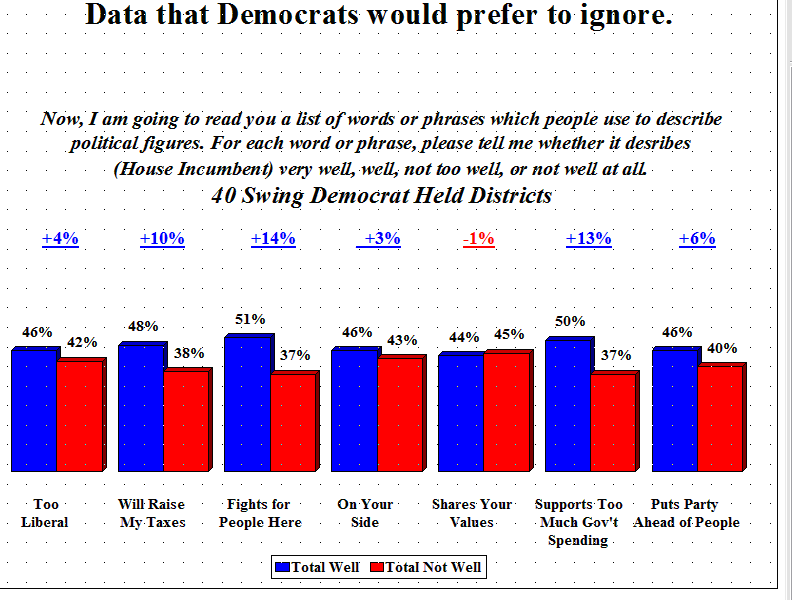
They also asked how well a series of descriptive phrases described the Democrat incumbents (or the GOP incumbents). The phrases do not bode well for Democrats. A plurality see their Dem incumbents as “too liberal,” “will raise my taxes,” and “puts (his/her) party in Washington ahead of the people here.” A majority say that their Dem incumbent in these swing seats “supports too much government spending.”
Meanwhile, Dem incumbents do get mixed marks for “being on your side,” and “shares your values.” The Dem does get majority credit for “fights for people here.”
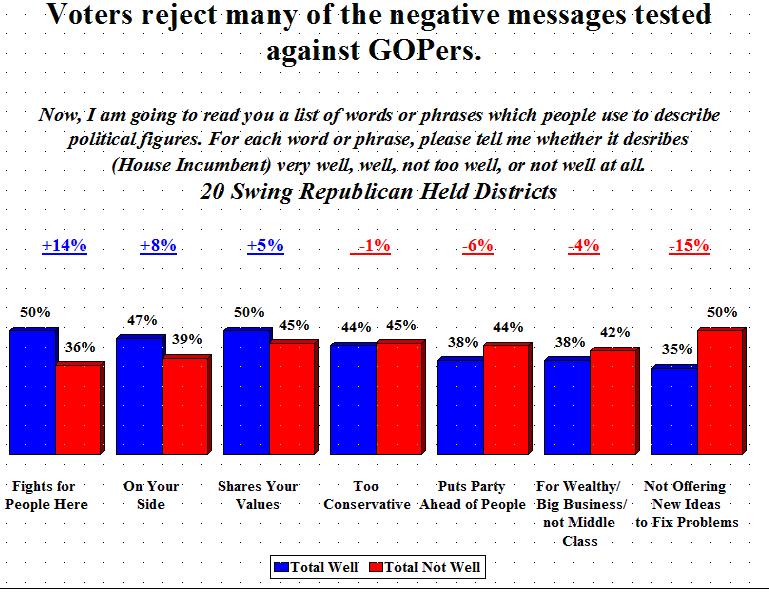
The folks at Democracy Corps had to be disappointed with the results of the descriptive phrases they asked in the target GOP districts. Just as many voters in those districts say the GOPer “fights for people here” as said in the Dem districts. The GOPer received a net five points better spread for “on your side” than the Dem incumbent did — and scored 13 points better on “shares your values.”
Voters in the GOP districts strongly rejected the negative message that their Republican incumbents “puts (his/her) party in Washington ahead of people here,” (thus the GOP incumbents run 11 net points better than the Dem incumbents on that measure).
The voters in the GOP districts also rejected the idea that their incumbent was “not offering new ideas to fix the country’s problems.” They were also skeptical of the claim that the Republican is “for the wealthy and big business, not the middle class.”
These data put a dent in the conventional wisdom that individual Republican incumbents are not getting some bounce off the Democratic Party’s problems. This is NOT a pox on both your houses of incumbents — instead, there are very real concerns with the Democratic party. For their 40 key swing seats to be having perceptual problems on being too liberal, too likely to raise taxes and spend too much money, and putting their party in DC ahead of the local folks is a real opportunity for Republican challengers.
There is currently a debate on whether the GOP is well-positioned enough to take advantage of the Dem problems. It’s a lot easier for the GOP to fix our fading problems than it is for the Dems to fix their growing problems. Elections aren’t about the past, they are about the right now. And, right now, it is going to be difficult for Dems to beat many GOP incumbents. The key question regarding GOP pick-ups is — what will “right now” look like in a year? If it looks like this — or better, the Dems will find that it isn’t their birthright to win congressional elections.
A friend kindly sent me this blog post on a recent Democracy Corps poll that did not receive the usual Democracy Corps publicity treatment (and their usual work is noted with envy, not criticism). In fact, as the blogger notes, there has been little to no press attention paid to the survey.
So, since my friends across the aisle at Democracy Corps didn’t spend a whole lot of time or focus analyzing the results for the public, I will do that heavy lifting for my faithful readers.
The survey was done October 6-11 among 1500 likely voters (1500! I wish our side could fund research like that!) in 40 Democratic-held and 20 Republican-held target House seats. They did 500 interviews in Democratic Tier 1 seats, 500 in Tier 2, and 500 in the GOP seats. The seats are the best of the best of the best (sir!). Democracy Corps did a similar survey back in April (40 Dem seats, 15 GOP seats, also 1500 total interviews).
As it has nationally, the political environment in these key districts has changed since April. The mood of the country has worsened a net ten points to 37% right direction/55% wrong track (from 41% RD/49% WT). President Obama’s job rating has dropped a net 20 points — from 55% approve/35% disapprove to 48%-48%. More voters now strongly disapprove (39%) than strongly approve (32%).
(The breakdown comparing Tier 1, Tier 2 Dem seats and the GOP seats is on the links to the surveys above.)
What is further noteworthy is their thermometer ratings — asking survey respondents to rate various people and organizations on a scale from zero (very cold, unfavorable) to 100 (very warm, favorable). The rating for the Republican Party is unchanged — a 43.9 in April, and a 43.5 now (that’s margin of error shift). However, the Democratic Party has dropped from a 49.0 in April to a 44.2 rating now.
The Democratic Congress has dropped from 46.2 to 41.2. The Republicans in Congress were at 43.7, but dropped a bit to 41.9 — one of the first ratings I’ve seen where GOPers score higher (albeit not by much) than Dems.
Democracy Corps also tested two key measures of ballot standing. In seats with an incumbent, they asked a two way re-elect (which is really the best wording of the myriad of re-elects out there). In April, Dem incumbents (and they gave the actual incumbent name) had a 39% re-elect/37% new person score. That’s down to 40% re-elect/45% new person now — a seven point shift against the Dem incumbents.
GOP incumbents have not had the same shift. In April they had a 39% re-elect/40% new person score, while in October it’s 40% re-elect/40% new person. These data show that Republican incumbents in swing seats are not out of the woods — but also that Dem incumbents in a similar situation are going deeper into the woods.
The generic ballot showed similar challenges for the Dems. In Dem seats, the Dem generic ballot lead shrunk from 39% GOP/52% Dem to 45% GOP/48% Dem (movement was similar in both Tier 1 and Tier 2). That’s a net ten point shift for the GOP challengers. However, Dem challengers went the wrong direction — in GOP seats in April, the GOPer lead 48%-42%. That lead is now 48%-39%.
Again, GOP numbers aren’t necessarily getting better (although the GOP challengers are getting more support), but the Dems are now having problems they did not have back in April.
The Democracy Corps survey has a LOT more interesting data on it — and I will be writing at least two more blog posts each of the next two days.
You would never know it by reading the rock-and-roll press: metal band AC/DC has sold more records in the U.S. than Michael Jackson or Bruce Springsteen. More than 200 million albums world-wide and trail only the Beatles as the second best selling act EVER. “Back In Black” is the second best-selling album in history – beaten only by The King of Pop’s “Thriller.” Staying power? Last year’s “Black Ice,” was the second best selling album IN THE WORLD.
Like congressional Republicans of late, the band did all this while being virtually ignored by the music press. They’ve never won a Grammy or MTV Music Award and have only been on the cover of Rolling Stone twice in 35 years. (Read more “Why AC/DC Matters.”).
Republicans should take solace and Democratic majorities in Congress take heed: it’s the numbers that decide their fate and not media Obamalove or Nobel Prize committees.
Here are five numbers that will decide the Democratic Party’s fate much more than a doting press corps.
#1. The mood of the country. When they are angry, the incumbent party suffers. Our most recent Public Opinion Strategies national survey showed only 38% believe the country is on the right track. Two recent cataclysmic reference points: in October of ‘94, this number was 27%; in ‘06 it was 29%.
#2. The president’s job approval. President Obama’s job approval has dropped from 63% measured in April to 51% measured in early September. When a president’s job approval drops below 50%, his party loses a historical average of 41 seats in the House.
#3. The unemployment rate. It’s currently 9.8%. The last midterms when the unemployment rate was close to this high was 1982 and Ronald Reagan’s party lost 26 seats in the House. AC/DC front man Brian Johnson got it right: Money DOES talk.
#4. The Consumer Confidence Index. When the CCI has been in the lower 90s, big changes have occurred (the 1978, 1982, 1994 and 2006 midterms). It is 53.1 now.
#5. The RELATIVE images of the two parties. Check out the NBC News/Wall Street Journal surveys. In 2002, the GOP had a net +6 advantage over the Democratic Party going into election day and the Democrats lost seven seats in the House. In ‘06, the GOP was -17 score and lost 30 seats; it carried a similar score (-20) into ‘08 and lost 24 more. Ouch: the GOP deficit sunk to -46% in December ‘08 AFTER election day. Clawing its way back, the GOP deficit shrunk to -26 by May and is now at -17.
As you know, I’ve been closely monitoring public opinion among Independents for some time now. A few of my recent postings have highlighted this key sub-group, noting their shift away from President Obama and the various policies he is trying to pursue.
Until now, these shifts have been emerging trends, but yesterday, Fox News/Opinion Dynamics released their latest poll* and the headline from it could not have been clearer: It’s Independents, stupid!
By almost a four-to-one margin they disapprove of the job Congress is doing (20{09f965da52dc6ab4c1643a77bd40d1f729d807040cd8db540234bb981a782222} approve, 77{09f965da52dc6ab4c1643a77bd40d1f729d807040cd8db540234bb981a782222} disapprove), and on every measure of President Obama’s job approval Independents are upside down.
Things don’t get any better when you look at where Independents fall out on the currently all-consuming health care debate. Just 23{09f965da52dc6ab4c1643a77bd40d1f729d807040cd8db540234bb981a782222} of Independents say they favor the health care reform legislation being considered while 62{09f965da52dc6ab4c1643a77bd40d1f729d807040cd8db540234bb981a782222} say they oppose it. Moreover, a majority (53{09f965da52dc6ab4c1643a77bd40d1f729d807040cd8db540234bb981a782222}) say they would prefer the current health care system compared to 28{09f965da52dc6ab4c1643a77bd40d1f729d807040cd8db540234bb981a782222} who would prefer the health care plan proposed by the Democrats in Congress; and only 17{09f965da52dc6ab4c1643a77bd40d1f729d807040cd8db540234bb981a782222} of Independents say they and their family would be better off under the health care reforms being considered, while more than twice as many (38{09f965da52dc6ab4c1643a77bd40d1f729d807040cd8db540234bb981a782222}) say they would be worse off.
As if that data isn’t bad enough news for the president, there are even more troubling numbers for him in this poll. By a margin of 13 points, Independents say in 2010 they are more likely to vote for a Republican candidate (35{09f965da52dc6ab4c1643a77bd40d1f729d807040cd8db540234bb981a782222}) to provide a check on Obama’s power over a Democrat (22{09f965da52dc6ab4c1643a77bd40d1f729d807040cd8db540234bb981a782222}) to help Obama pass his policies. And, if the 2012 election were held today 35{09f965da52dc6ab4c1643a77bd40d1f729d807040cd8db540234bb981a782222} of Independents say they would reelect President Obama while almost half (48{09f965da52dc6ab4c1643a77bd40d1f729d807040cd8db540234bb981a782222}) say they would vote for someone else.
This poll provides a very clear picture of what’s going on in the electorate. Independents aren’t just starting to shift away from the president, they are beginning to flee. This is one of the core groups that helped Obama get to the White House. Losing them this quickly and to this degree only spells more trouble ahead for the president and provides an opportunity for Republicans to reach out to these important voters as the 2010 elections approach.
*National survey of 900 registered voters conducted October 13-14, 2009.
The story shaping up for the 2009 elections might be Republican vote intensity.
We witnessed this Republican enthusiasm last week in the Albuquerque mayor’s race.It is one thing to say polling indicates we could have a high Republican turnout election.It is quite another to see it work first-hand.In Albuquerque, Republicans were just chomping at the bit to cast their ballot.
Our firm conducted research and played a key advisory role to the successful campaign of newly elected Mayor Richard “R.J.” Berry.
In a city where Democrats crush Republicans in registration, the number of Republicans who voted absentee in the city election actually surpassed Democrats.Of the absentee ballots cast in this election, 49% were sent in by Republicans, 44% by Democrats, and 7% by other. Republican party registration in the city is just 32% — that means a 17% overperformance in the return of absentee ballots.
Republicans also outperformed their registration in early in-person voting, comprising 39% of the total votes cast, which is a good showing considering Democrats had rigged early voting so that three of the four early voting sites were in heavily Democratic areas of town, and none near Republican strongholds. One site was actually in City Hall, the Democrat bastion for the last three decades and home to three-term Democrat mayor Martin Chavez who was running for re-election (again).
The message was clear … Republicans wanted to get their votes in, and the sooner the better.
So, can we say that the election was about Obama and Republican furor at runaway government?Well, the “Obama” name was never used in any direct way in the Berry for Mayor campaign.But themes of the government growth and wasteful spending were at the heart of the mayoral campaign.Nothing ticks off Republicans (and Independents for that matter) more than government run amok.Voters witness it on the federal level, and it fans the flames in local elections.
Granted, there are several unique features of the Albuquerque mayor’s race that created an environment for a Republican to be elected.But, Richard Berry won 44% of the vote in a three-way race in a heavily Democratic city.Local commentators and pundits gave Berry little chance to even get in a run-off, much less win the election outright.The campaign worked for their votes in this election… they chased votes, made phone calls, implored voters to cast their ballot.But, 44% of the vote and erasing the significant Democrat registration advantage signals something else … a powerful Republican force is at work this year.
Look for it in Virginia to be sure, and for the force to carry into 2010.
 Things don’t get any better when you look at where Independents fall out on the currently all-consuming health care debate. Just 23{09f965da52dc6ab4c1643a77bd40d1f729d807040cd8db540234bb981a782222} of Independents say they favor the health care reform legislation being considered while 62{09f965da52dc6ab4c1643a77bd40d1f729d807040cd8db540234bb981a782222} say they oppose it. Moreover, a majority (53{09f965da52dc6ab4c1643a77bd40d1f729d807040cd8db540234bb981a782222}) say they would prefer the current health care system compared to 28{09f965da52dc6ab4c1643a77bd40d1f729d807040cd8db540234bb981a782222} who would prefer the health care plan proposed by the Democrats in Congress; and only 17{09f965da52dc6ab4c1643a77bd40d1f729d807040cd8db540234bb981a782222} of Independents say they and their family would be better off under the health care reforms being considered, while more than twice as many (38{09f965da52dc6ab4c1643a77bd40d1f729d807040cd8db540234bb981a782222}) say they would be worse off.