I wanted to get to this early September poll by AP-Gfk sooner, but time got away from me. However, the data is so compelling it is still worth reviewing.
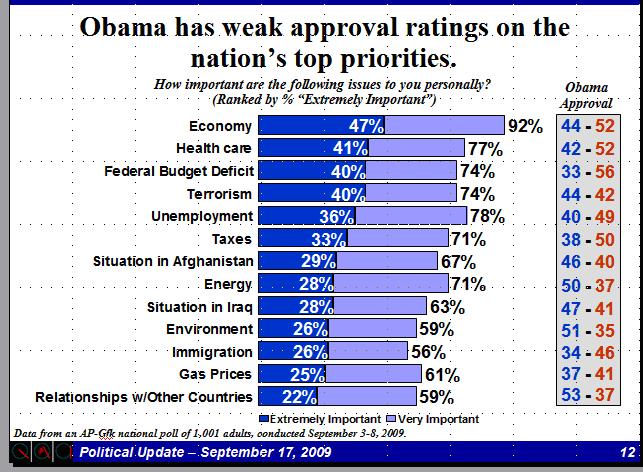
The key finding of the survey — as highlighted by the chart below — is that Barack Obama has a net negative rating on five of the top six issues to voters: the economy, health care, the budget deficit, unemployment, and taxes. Only on terrorism does he receive a mixed grade (44{09f965da52dc6ab4c1643a77bd40d1f729d807040cd8db540234bb981a782222} approve/42{09f965da52dc6ab4c1643a77bd40d1f729d807040cd8db540234bb981a782222} disapprove).
Thus, while voters still like Obama personally, he has negative issue approval scores on the top issues of the day. Ultimately, his deteriorating issue approval scores will pull down his overall approval score.
Obama does receive positive marks on Afghanistan, energy, Iraq, the environment, and relationships with other countries, but those are five of the seven lowest issues of importance to voters. In fact, his highest issue approval rating (53{09f965da52dc6ab4c1643a77bd40d1f729d807040cd8db540234bb981a782222} approve/37{09f965da52dc6ab4c1643a77bd40d1f729d807040cd8db540234bb981a782222} disapprove) comes on the issue least important to voters of the 13 tested — “relationships with other countries.”
This reinforces the need for Republicans to continue to define President Obama (and the Democrats in Congress) on issues. Bad ideas on health care, making the deficit much worse, raising taxes, and doing nothing to help the economy and unemployment. That’s a pretty potent issue message.
Republicans do need to show we have ideas of our own — but most of this election will be fought over the Democrats’ handling of these top issues.
In June, I wrote a piece noting that Independents – one of President Obama’s electoral keys to the White House – appeared to be experiencing some buyers’ remorse on their 2008 vote decision.
It’s just a few months later, and less than a year since Obama took office, but it seems the American public, and especially Independents, are finding out what it is they signed up for at the ballot box last November…and they don’t like it.
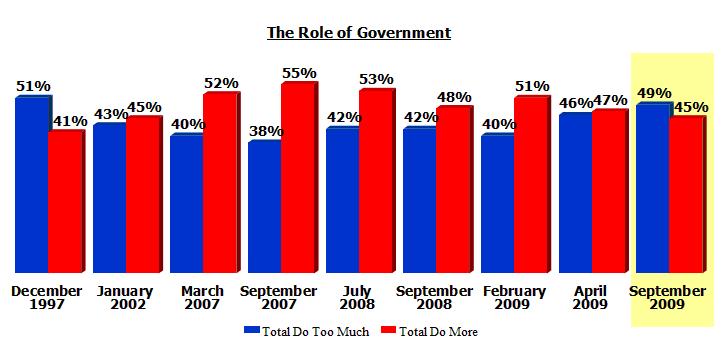
Throughout the 2008 campaign, and even immediately following President Obama’s inauguration, our NBC/WSJ polls showed us Americans leaned towards the belief that “government should do more to solve problems and help meet the needs of people” rather than the belief that “government is doing too many things better left to businesses and individuals.”
In April, this year, just about the time Independents were beginning to express some concerns, the pendulum started to swing back, and the public was evenly divided on this measure. But today, for the first time since 1997, more people are inclined to say the government is doing too many things.
After watching President Obama impose government control on the banking, housing, and auto industries, and now trying a government overhaul of the health care system perhaps it’s not surprising we’re seeing this trend back towards less government intervention.
The groups who shifted the most on this measure are men, Southerners, Westerners, babyboomers, professionals, small town/rural residents….and, you’ll never guess…yes, Independents, who moved from favoring more government intervention by two points in February (46{09f965da52dc6ab4c1643a77bd40d1f729d807040cd8db540234bb981a782222} government should do more, 44{09f965da52dc6ab4c1643a77bd40d1f729d807040cd8db540234bb981a782222} government is doing too much) to a 21-point preference today for less government intervention (35{09f965da52dc6ab4c1643a77bd40d1f729d807040cd8db540234bb981a782222} government should do more, 56{09f965da52dc6ab4c1643a77bd40d1f729d807040cd8db540234bb981a782222} government is doing too much).
And, not only are Independents changing their mind on how much government intervention they want, they’re also having a change of heart about Obama. For the first time since he took office, in this month’s NBC/WSJ poll,* Independents give the president a net negative job approval rating (41{09f965da52dc6ab4c1643a77bd40d1f729d807040cd8db540234bb981a782222} approve, 46{09f965da52dc6ab4c1643a77bd40d1f729d807040cd8db540234bb981a782222} disapprove). They are also upside down on their approval of his handling health care reform (35{09f965da52dc6ab4c1643a77bd40d1f729d807040cd8db540234bb981a782222} approve, 53{09f965da52dc6ab4c1643a77bd40d1f729d807040cd8db540234bb981a782222} disapprove), his handling of the economy (40{09f965da52dc6ab4c1643a77bd40d1f729d807040cd8db540234bb981a782222} approve, 47{09f965da52dc6ab4c1643a77bd40d1f729d807040cd8db540234bb981a782222} disapprove), and barely break even on his handling of foreign policy (40{09f965da52dc6ab4c1643a77bd40d1f729d807040cd8db540234bb981a782222} approve, 41{09f965da52dc6ab4c1643a77bd40d1f729d807040cd8db540234bb981a782222} disapprove).
These numbers are troubling for the president who is already faced with fissures among the Democratic Caucus. With Independents reversing course, and without the unified support of his own Base, President Obama faces a rocky road ahead. Republicans should continue to offer alternative solutions to big government and remind voters – especially Independents – that elections have consequences and there’s a chance for a mid-course correction in 2010.
*National survey of 1,005 adults conducted September 17-19, 2009
(Public Opinion Strategies partners with Peter D. Hart Research Associates to conduct the NBC/WSJ polls. Neither Peter D. Hart Research Associates nor NBC/WSJ are responsible for these conclusions.)
Results of the latest NBC-Wall Street Journal survey conducted by Bill McInturff of Public Opinion Strategies and Peter Hart of Hart Research Associates are available. The national survey was conducted September 17-20, 2009 among 1,005 adults. The full results can be found here.
By: Dave Wilson
This article highlights key findings from a merge analysis conducted by Public Opinion Strategies of all interviews conducted by the firm on national surveys since 2004. This merge analysis contains more than 100,000 interviews (and growing) and is a valuable tool for tracking demographic and attitudinal shifts over time. For more information about this merge analysis, please contact us at info@pos.org.
Below, please find a number of key findings among white working men drawn from POS merge data from 2004-2009.
1. White working men are the most Republican they have been since 2004.
While the size of the white working male subgroup has shrunk in recent years, white working men have trended to become more Republican than they have in the past several years (see table below).
2. While this group has become more Republican, it has become a smaller portion of the overall electorate.
The percentage of the electorate made up of white working men has shrunk to 17% thus far in 2009 (see above table). This is a drop of nine percent since 2005 (when they made up a high of 26% of the electorate), and a four percent drop-off from 2007 and 2008, when 21% of the electorate was made up of white working men. For a subgroup that is majority Republican, this is a troublesome decline for the Republican Party.
This slide has been a part of the decline in Republican party ID that has occurred nationally over the past several years. However, thus far in 2009, there has been a slight increase in the number of Republican white working males as a percentage of the overall electorate than there has been over the past couple of years. The party must continue to work to strengthen its grasp on this portion of the electorate to improve its current standing nationally.
3. Conservatives make up a larger portion of white working men in 2009 than any previous year of merge data.
In 2004, 43% of white working men considered themselves to be conservative, compared to just 17% who are liberal, and 39% who consider themselves moderate. In the years between 2005 and 2008, white working men hovered between 44-45% conservative. However, this year, conservative white working men have upticked slightly, with just under half (49%) of all white working men now considering themselves to be conservative. Twelve percent (12%) are self described liberals, and 38% consider themselves moderate.
4. There has been a decided movement towards suburban living for white working men.
While there has been little change in what region of the country white working men reside in, there has been an increase since 2004 in the percentage of white working men living in the suburbs. In 2004, half (50%) of all white working men lived in the suburbs. By 2006, the expansion of the suburbs increased the percentage of white working men living there to 56%, and by 2008, it hit a high of 58%. Thus far in 2009, 56% of all white working men are classified as living in the suburbs. Over the same time, rural and urban codes have traded positions with one another as the second most populous area for white working men, with urban (23%) outranking rural (21%) in 2009 as the second most populous area where white working men reside.
5. While there have been some shifts over the last five years, there has been no change in education level among white working men since 2004 when compared to 2009.
In 2004, one half (50%) of white working men were college graduates, one quarter (25%) attended some college, and another 25% completed high school or had less educational training. There was a slight increase in 2008 to 54% college graduates (some college and high school or less both lost two percentage points each, down to 23% of white working men); however, by 2009, education levels returned to where they were in 2004, with 50% college graduates, and both some college and high school or less coming in at 25% a piece.
6. The generic Congressional ballot has grown steadily more Republican among white working men since 2004.
Thus far in 2009, there have not been a substantial number of interviews asking the generic Congressional ballot to draw valid conclusions from; however, the 2008 data shows that the generic ballot has trended Republican among white working men since 2004 (see table below).
7. Economy and jobs, Iraq, and terrorism and national security are consistently the three most important issues to white working men.
While there is not significant enough data so far in 2009 on the MIP issue question to draw any conclusions, in the preceding five years, economy and jobs topped the issue agenda among white working men three times, while Iraq (2007) and terrorism and national security (2004) topped the issue agenda among white working men one time apiece. These three issues rotated as the top three issues for every year of this analysis, with no other issues jumping into the top three.
The Bottom Line
With white working men trending more and more conservative and returning to 2004 levels of Republican party identification, over the six years of data in this analysis, there was a promising shift in the generic ballot as well. However, the group is currently the smallest portion of the electorate it has been since at least 2004. With white working men becoming a continually smaller group, the Republican party must firm up its grasp on this key subgroup, which if the 2009 data holds, the wheels are in motion to accomplish this.
Methodology
This analysis was completed using POS merge data from 2004-2009. Total interviews per year (percent of overall electorate in parentheses) for white working men: 2004 – 3,863 (24%), 2005 – 6,015 (26%), 2006, 5,854 (25%), 2007 – 4,056 (21%), 2008 – 2,035 (21%), 2009 – 818 (17%).
By: Lisa Valentine
This article highlights key findings from a merge analysis conducted by Public Opinion Strategies of all interviews conducted by the firm on national surveys since 2004. This merge analysis contains more than 100,000 interviews (and growing) and is a valuable tool for tracking demographic and attitudinal shifts over time. For more information about this merge analysis, please contact us at info@pos.org.
Over the past five years, suburban women have become a larger subgroup in the American electorate. In 2008, suburban women comprised fully 28% of the overall sample, an increase of six percentage points from 2004, when they made up roughly 22% of the overall sample.
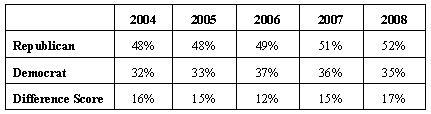
And, while this subgroup has increased in overall size, this demographic has had a gradual shift in party identification, moving closer to the Democratic Party (see table below).
In 2004, 39% of suburban women were self-identified as Republicans and 44% as Democrats. In 2009, only 37% of suburban women were self-identified as GOP’ers while 48% were Democrats. The gap has grown from -5% to -11% in only five short years, which is troubling, since as suburban woman have increased within the electorate, they are moving away from the Republican Party.
This is not to say that there is an inherent Democratic base among suburban women. In 2004, suburban women had a net positive approval rating of President George W. Bush (50%-47%) and Bush was essentially tied on the ballot test versus Kerry (46%-47%). Republicans, and George W. Bush in particular, were able to win over these key women voters because the party’s focus was on national security.
However, as the top issue priority has shifted among suburban women from national security/terrorism/war on terror to the economy and healthcare, Bush’s favorability and their overall support of the Republican Party began to deteroriate. The political environment became more a referendum on domestic issues and Bush’s unfavorability and the Republican Party lost support among suburban women.
In 2004, terrorism and the war in Iraq was the number one concern among suburban women (44%), followed by the economy and jobs (41%). We have seen a significant shift, and in 2009, only 10% of suburban women listed terrorism and the war in Iraq as their top issue priority, whereas 69% stated their top issue was the economy and jobs.
Who Are Suburban Women in 2009?
Suburban women in 2009 are well-educated (48% college+), tend to have a higher household income (52% earn $60K or more), and are more likely to be married (62%). Suburban women are slightly more likely to have children than the general population (45% compared to 40%), and are more likely to be “working women” (39%) compared to women in the general population (20%).
These women, while they are starting to skew more Democratic in party ID (37% GOP – 48% DEM) and supported Barack Obama over John McCain in 2008 by twelve points (41% McCain -53% Obama), they still consider themselves more moderate (40%) and conservative (38%) than liberal.
Due to the current economic environment, it is not surprising that the economy and jobs are the top issue priority for these women (69%). However, if the economy is able to stabilize, it could create an opportunity for Republicans to talk to these women on other key issues.
Bottom Line
Since suburban women are becoming a larger sub-group, the Republican Party needs to find a way to bring them back. These women are concerned about the economy, health care, and education and we need to create a message that resonates with their concerns. The focus should be about promoting a strong economy that will bring back jobs and reforming health care to hold down costs, in contrast to policies that are currently being promoted by the Democratic Party in Congress and the Obama Administration.
Along with targeting a message that resonates with these suburban women, the Republican Party still has the opportunity to bring them back by highlighting areas in which the public trusts the Republican Party to do a better job – such as domestic security, national security, controlling government spending, and lowering taxes for middle class families.